At work, fire extinguishers are typically used by designated, trained employees such as emergency response team members, floor wardens, and staff in higher-risk areas, and only when a fire is small and an exit remains clear. Supervisors and employers are responsible for providing the right extinguishers, keeping them accessible, inspecting them, and arranging initial and refresher training. Fire wardens check locations, visibility, and servicing needs. The sections below explain when to act, when to evacuate, and common mistakes.
Key Takeaways
- Designated, trained employees (emergency response team, floor wardens, high-risk area staff) are responsible for using extinguishers when safe.
- Supervisors ensure that extinguishers are accessible, inspected, and users receive initial and refresher training with documented proficiency.
- Fire wardens verify extinguisher visibility, mounting, and access, conduct routine checks, and coordinate servicing and location briefings.
- Employers must provide correct extinguisher types and quantities, maintain them to code, and ensure clear instructions and labeling.
- All occupants should prioritize evacuation, raise the alarm, and only attempt extinguisher use on small fires with a clear exit route.
Table of Contents
Who Should Use a Fire Extinguisher at Work?
In most workplaces, who should use a fire extinguisher is determined by training, authorisation, and the specific hazards present. Employers typically designate certain employees as fire extinguisher users within the emergency action plan, giving them clear authority to act without confusion or micromanagement.
These users are usually members of an emergency response team, floor wardens, or selected staff in higher-risk areas such as kitchens, maintenance shops, laboratories, and warehouses. They receive hands-on instruction on extinguisher classes, safe approach, and limits of operation, plus refresher practice.
Supervisors support this role by ensuring access, inspections, and time for training, while safety officers document assignments and compliance. Other employees are not expected to improvise; their responsibility is to keep exits clear, report hazards, and respect posted rules. Visitors and contractors follow the site policy and assigned escorts.
When to Use a Fire Extinguisher vs Evacuate
Two decisions matter in the first seconds of a workplace fire: attempt to extinguish it or evacuate immediately. A fire extinguisher is for small, contained incipient fires where a clear exit remains available, and the action does not trap anyone. Evacuation is the default when fire, smoke, or heat threatens breathing, visibility, or freedom of movement, or when the fire involves rapidly spreading fuels.
| Condition | Right move |
| Flames are limited to a small area | Extinguish, if escape stays open |
| Smoke building or visibility dropping | Evacuate and close doors behind you |
| Fire spreading beyond a single object | Evacuate; let trained responders handle it |
| Hazardous materials or an unknown source | Evacuate; do not gamble with exposure |
| Any doubt about control or time | Evacuate; personal safety stays sovereign |
This choice protects autonomy: no one is obligated to trade health for property. Know about what fire extinguisher for electrical fire.
What to Check Before You Tackle a Fire
Before anyone pulls a pin, several quick checks determine whether using an extinguisher is a controlled intervention or a risk multiplier: the fire must be small and contained, the correct extinguisher class must be available and charged, a clear escape route must remain behind the person at all times, smoke and heat must be low enough to allow safe breathing and visibility, and the alarm should already be raised so evacuation and response are underway if suppression fails.
Next, the person should size up what is burning paper, fuel, cooking oil, energised equipment because the wrong agent can spread flame, trigger flashback, or add shock risk. Wind and ventilation matter; a strong draft can push fire faster than anyone can move. If clothing, hair, or nearby materials could ignite, withdrawal is the freer choice.
The extinguisher’s gauge, pin, hose, and nozzle should be intact, and the discharge path unobstructed. If a single short burst does not reduce flames, autonomy means leaving immediately and closing doors behind.
What Employers Must Provide and Enforce
Although a fire extinguisher is handheld, its safe use depends on employer-controlled systems: providing the correct extinguisher types and quantities for identified hazards, placing and maintaining them to code, and enforcing training and drills so employees know when to use an extinguisher and when to evacuate.
Employers must supply clear access, visible signage, and unobstructed routes so no one is forced to choose between personal safety and property. They must guarantee monthly visual checks, scheduled servicing by qualified technicians, and prompt replacement after discharge or damage.
Employers must post straightforward instructions, label extinguisher classes, and standardise locations so response is not guesswork. Training must cover PASS operation, limits of extinguishers, shutdown procedures, and the right to leave immediately when heat, smoke, or uncertainty rises.
Enforcement matters: supervisors should correct blocked cabinets, expired tags, and unsafe heroics, rewarding disciplined evacuation as much as quick suppression.
How Fire Risk Assessments Set Extinguisher Needs
When a fire risk assessment is completed, it defines exactly which fire scenarios are credible in a space and, consequently, what extinguisher types, sizes, and numbers are justified. It maps ignition sources, fuel loads, and occupancy so protection matches reality rather than habit or guesswork.
Where cooking oils exist, wet chemical units become non‑negotiable; where energized electrical gear is present, nonconductive agents are prioritized; where ordinary combustibles dominate, water or foam may be sufficient. The assessment also sets placement rules: travel distance to an extinguisher, visibility, mounting height, and whether extra units are needed for separated rooms, high fire load zones, or multi‑level layouts.
It accounts for special constraints such as confined areas, vulnerable occupants, or high‑value assets that demand faster first‑aid firefighting. By tying equipment to measured risk, it avoids both under‑protection that limits choices and over‑provision that wastes money and space.
What Fire Wardens Do With Extinguishers
A fire risk assessment determines what extinguishers should be provided, but fire wardens influence how those units are positioned, checked, and used in practice. They act as practical stewards of readiness, keeping equipment accessible without turning the workplace into a maze of rules.
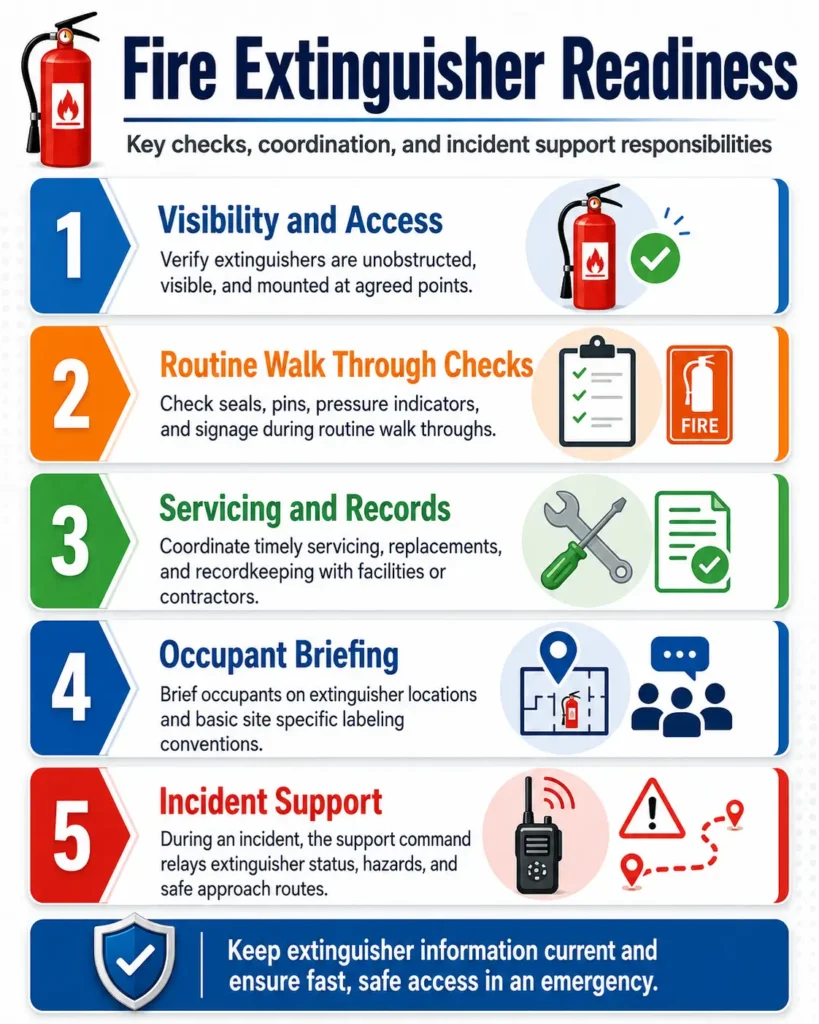
Fire wardens also spot repeat issues blocked cabinets, missing labels, unsuitable placement and push for fixes that preserve personal choice while reducing needless risk. The goal is simple: equipment that can be reached quickly, works as intended, and is managed without micromanagement or chaos.
What Employees Can Do (and When to Stop)
Act early: employees can keep extinguisher access clear, notice obvious damage or missing signage, and report issues promptly, but their role during a fire is limited to tackling only a very small, contained incident if trained, the correct extinguisher is immediately available, and the escape route remains open.
They are not expected to “be the hero” or trade personal safety for property. If smoke thickens, flames spread beyond a wastebasket-sized area, the fire involves energised electrical equipment, pressurised cylinders, or unknown chemicals, or a single extinguisher does not make immediate progress, they should stop and leave.
Employees protect everyone’s freedom to work and go home by choosing evacuation over escalation. The priority is to alert others, trigger the alarm, call emergency services as required, and close doors behind them if it can be done without delay.
Once outside, they should account for colleagues and never re-enter.
Fire Extinguisher Training: What “Competent” Means
Too often, “competent” fire extinguisher use is mistaken for simply knowing where the units are stored. In safety programs, competence means a verified ability to act decisively and lawfully, without waiting for permission when seconds matter.
It is built through hands-on practice, clear boundaries, and periodic evaluation, so individuals can protect life and property while preserving their own autonomy.
Competent training typically confirms that a person can:
- Identify extinguisher classes used on-site and match them to common fuel types
- Perform a quick scene assessment and choose when to disengage and alert responders
- Operate the specific extinguisher models provided, including pin, nozzle, and discharge controls
- Maintain safe positioning, exit awareness, and communication with nearby occupants
- Follow site policy, documentation, and local code requirements for emergency response
Supervisors support this by scheduling refreshers, documenting proficiency, and ensuring equipment is accessible, inspected, and clearly labeled for independent action.
Common Fire Extinguisher Mistakes to Avoid
Although many incidents are small enough to control with a portable extinguisher, preventable errors often turn a manageable fire into an evacuation or injury. A common mistake is grabbing the wrong class of extinguisher, especially when using water on flammable liquids or energized equipment. Learn the Types of fire and fire extinguisher.
Another is skipping the quick risk check smoke, heat, and blocked exits demand immediate escape, not heroics. People also forget PASS basics: pulling the pin, aiming at the base, squeezing, and sweeping; aiming at flames wastes agent.
Standing too close, or with no exit behind, invites entrapment if the fire flares. Underestimating re-ignition is frequent; once the extinguisher empties, a continued flare-up requires retreat and calling emergency services. Neglecting inspections low pressure, damaged hoses, missing tamper seal creates false confidence when seconds matter. Freedom depends on disciplined, informed choices, not panic-driven improvisation.
Frequently Asked Questions
Can I Use a Fire Extinguisher at Home Without Formal Training?
Yes, a homeowner can use a fire extinguisher without formal training, but only for small, contained fires. They should read labels, keep an exit behind, call emergency services, and evacuate if unsure.
How Often Do Fire Extinguishers Need Professional Servicing and Inspection?
Fire extinguishers typically need annual professional inspection and servicing; some types require internal maintenance every 5–6 years and hydrostatic testing every 10–12 years. Local codes may differ, empowering homeowners to choose compliant schedules.
Which Fire Extinguisher Types Are Safe to Use on Electrical Equipment?
For electrical equipment, CO2 and dry chemical (ABC/BC) extinguishers are generally safe because they’re non-conductive. Clean agent units also work. Water or foam should be avoided until power is disconnected, preserving safety and choice.
What Legal Liabilities Apply if I Misuse a Fire Extinguisher?
Misuse can trigger civil negligence claims, property-damage liability, and personal-injury lawsuits; in some jurisdictions, it may invite criminal charges for recklessness or false alarms. Liability rises when training is ignored, warnings are defied, or harm is foreseeable.
How Should Expired or Discharged Fire Extinguishers Be Disposed Of?
Expired or discharged extinguishers should be depressurised, tagged, and taken to an authorised fire-equipment service or hazardous-waste facility; recyclable steel can be scrapped. Local rules vary avoid illegal dumping. Keep records, choose providers respecting personal choice.
Conclusion
Responsibility for using a fire extinguisher at work rests on trained, competent individuals, guided by clear procedures and a robust fire risk assessment. Employers must provide suitable equipment, instruction, and enforcement, while fire wardens support evacuation and, where safe, initial firefighting. Employees may act only within training and only if conditions remain controlled. Knowing when to stop and evacuate is as important as knowing how to operate an extinguisher.