
If you are researching what are the 3 types of boilers, the three main types commonly found in UK homes are combi boilers, system boilers and regular boilers. Each type works differently and has its own advantages and limitations depending on the size of the property, the number of bathrooms, hot water demand, available space and the existing heating system.
Choosing between these three boiler types is not simply a question of which one is the newest. A combi boiler may be suitable for a smaller property with relatively straightforward hot water requirements, while a system or regular boiler may be more appropriate for a larger home with several bathrooms or higher simultaneous hot water demand.
Understanding how each system works can help homeowners, landlords and property managers make sense of their existing heating arrangement and understand what may be involved when replacing an older boiler.
Key Takeaways
- The three main domestic boiler types in the UK are combi, system and regular boilers.
- Combi boilers provide heating and hot water without a separate hot water cylinder.
- System boilers work with a hot water cylinder and are suitable for higher hot water demand.
- Regular boilers, also called conventional or heat only boilers, normally work with a hot water cylinder and cold water storage cistern.
- The best boiler type depends on the property, water demand, available space and existing heating system.
- Replacing a boiler with a different type can require changes to the plumbing and heating system.
Table of Contents
What Are the Three Main Types of Boilers?
The three main types of domestic boilers commonly installed in UK properties are combi boilers, system boilers and regular boilers.
Although all three can provide central heating, their methods of producing and storing hot water are different.
A combi boiler heats domestic hot water directly when a tap or shower requires it. It does not normally require a separate hot water cylinder or cold water storage tank.
A system boiler heats water for storage in a separate hot water cylinder. Many of the major components required for the heating system are built into the boiler itself, making the installation more streamlined than a traditional regular boiler system.
A regular boiler, sometimes called a conventional or heat only boiler, normally works with a separate hot water cylinder and cold water storage cistern. It is often found in older UK homes and may be particularly useful where an existing heating system already uses stored hot water.
1. Combi Boiler
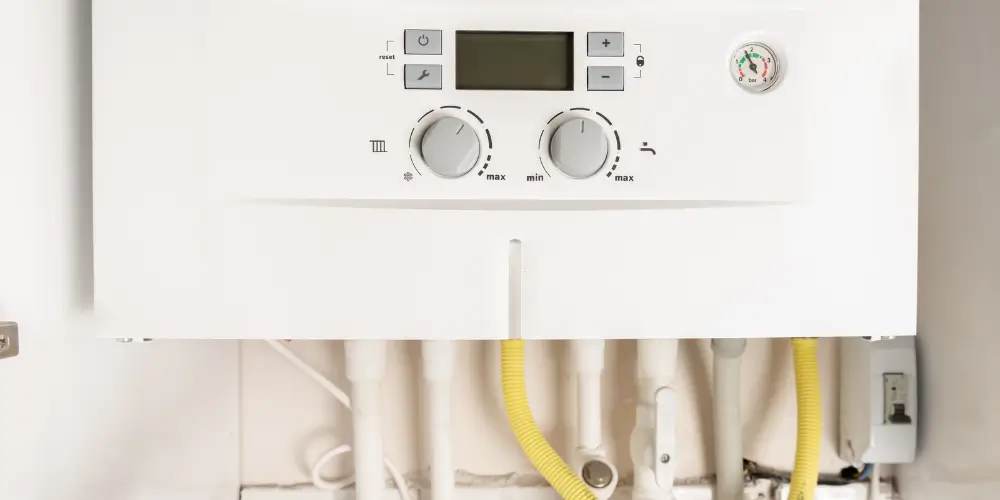
A combi boiler, short for combination boiler, combines central heating and domestic hot water production within one appliance.
When a hot tap or shower is turned on, the boiler heats water directly from the mains supply. There is normally no need for a separate hot water cylinder because hot water is produced when it is required.
This makes combi boilers particularly attractive where space is limited. Removing the need for a separate cylinder can free up valuable cupboard or airing cupboard space.
Combi boilers are commonly found in flats, smaller houses and properties where hot water demand is relatively straightforward. However, their suitability depends on the mains water supply, incoming water pressure and flow rate as well as the household’s hot water requirements.
Homeowners considering this option can also explore how much a combi boiler costs in the UK to understand installation expenses and pricing factors.
How Does a Combi Boiler Work?
A combi boiler has two main functions. It provides hot water for the central heating system and heats domestic water when a hot tap or shower is opened.
When there is a demand for hot water, the boiler detects the flow and directs heat towards the domestic hot water circuit. Water is heated as it passes through the boiler rather than being stored in a cylinder. Knowing the common causes of no hot water from a combi boiler can also help homeowners recognise potential performance problems.
When there is no hot water demand, the boiler can operate the central heating system when the thermostat or heating controls request heat.
Because hot water is produced directly, the available flow rate can be affected by the incoming mains supply. A property with low mains pressure or a low flow rate may therefore need a different solution.
Advantages of a Combi Boiler
One of the main advantages of a combi boiler is its compact design. Because there is normally no separate hot water cylinder or cold water storage cistern, the system can take up less space.
Another advantage is that hot water is available on demand. There is no requirement to heat and store a cylinder of water before using it.
Combi boilers can also simplify the plumbing arrangement because the boiler combines several functions within one appliance.
For households with moderate hot water requirements, this arrangement can be convenient and efficient.
Limitations of a Combi Boiler
A combi boiler may not be the ideal choice for every property.
Because hot water is produced directly, performance depends partly on the incoming mains water flow and pressure. A household attempting to run several showers or hot water outlets simultaneously may find that a single combi boiler is not the most suitable arrangement.
There can also be limitations when a property has particularly high simultaneous hot water demand.
The size and output of the boiler should therefore be selected based on the property’s heating and hot water requirements rather than simply choosing the largest available appliance.
2. System Boiler
A system boiler provides central heating and works with a separate hot water cylinder.
Unlike a regular boiler system, many of the major components required for the heating system are incorporated into the system boiler itself. This can make the installation more compact and reduce the number of separate components that need to be installed around the property.
The hot water cylinder stores heated water so that it can be supplied to taps and showers when required.
System boilers can be particularly useful for larger households where there is greater demand for hot water or where multiple outlets may need to operate.
How Does a System Boiler Work?
A system boiler heats water that circulates around the central heating system. It also heats domestic hot water that is stored in a separate cylinder.
The cylinder acts as a reservoir of hot water. Once heated, the stored water can be delivered to multiple outlets around the property.
The system is controlled using appropriate heating and hot water controls. The boiler can heat the cylinder according to the programmed schedule, while the central heating operates according to the requirements of the occupants.
Because hot water is stored before it is required, a system boiler can provide a substantial volume of hot water at the same time.
Advantages of a System Boiler
One of the main advantages of a system boiler is its ability to work effectively with a hot water cylinder.
This can make it suitable for larger properties with several bathrooms or households where multiple people may require hot water around the same time.
Unlike a traditional regular boiler system, a system boiler does not normally require a separate cold water storage cistern because the domestic water supply to the cylinder is generally fed directly from the mains.
This can reduce the amount of equipment required in the loft and can make a system boiler installation more straightforward than a conventional arrangement.
Limitations of a System Boiler
The main consideration is space.
A system boiler requires a separate hot water cylinder, so sufficient space must be available for the cylinder and associated pipework.
There is also a finite amount of hot water stored in the cylinder. Once the stored supply has been used, the boiler needs to heat more water.
The cylinder and associated controls also require appropriate maintenance and must be correctly sized for the household’s requirements.
3. Regular Boiler
A regular boiler is also known as a conventional, traditional or heat only boiler.
This type of system normally uses a separate hot water cylinder and a cold water storage cistern, often located in a loft or another suitable location.
Regular boilers are commonly found in older properties, particularly homes that were originally designed around traditional central heating systems.
They can be useful where a property already has a suitable regular boiler arrangement and where there is a requirement for stored hot water.
How Does a Regular Boiler Work?
A regular boiler heats water for the central heating system and also heats water stored in a separate hot water cylinder.
The cold water storage cistern supplies water to the heating and hot water system. When the boiler heats the water, it is stored in the hot water cylinder until it is needed.
The stored hot water can then be supplied to taps, baths and showers.
Because the system uses a separate water storage arrangement, the available hot water can be less dependent on the instantaneous mains flow than a combi boiler.
Advantages of a Regular Boiler
A major advantage of a regular boiler is its compatibility with traditional heating systems.
If a property already has a regular boiler, hot water cylinder and cold water storage cistern, replacing the existing boiler with another suitable regular boiler can sometimes be more straightforward than converting the entire system to a different boiler type.
Regular systems can also be appropriate for larger properties with substantial hot water requirements.
Another advantage is that the stored hot water can supply several outlets simultaneously, provided the cylinder and wider system have been correctly sized.
Limitations of a Regular Boiler
The main disadvantage is the amount of equipment required.
A traditional regular boiler system normally requires the boiler, hot water cylinder and cold water storage cistern, together with associated pipework and controls.
This means that more physical space is required compared with a typical combi installation.
There can also be a delay between using the stored hot water and producing another full cylinder of hot water. The exact recovery time depends on the boiler output, cylinder size and system controls.
What Is the Difference Between a Combi, System and Regular Boiler?
The biggest difference between the three boiler types is how domestic hot water is produced and stored.
A combi boiler heats domestic hot water directly when it is required. It normally does not use a separate hot water cylinder.
A system boiler heats water for storage in a separate hot water cylinder but incorporates many of the main heating components within the boiler.
A regular boiler normally works with both a hot water cylinder and a cold water storage cistern.
The right option therefore depends on how much hot water the household needs, how many bathrooms the property has, the available space and whether the existing heating system is suitable for conversion.
Combi vs System Boiler
Choosing between a combi and system boiler often comes down to hot water demand and available space.
A combi boiler can be convenient for households that want hot water directly from the boiler without maintaining a separate cylinder. It can also be useful where space is restricted.
A system boiler can be more appropriate where several people need hot water simultaneously because the cylinder provides a stored supply.
However, a system boiler requires space for the cylinder, whereas a combi boiler normally does not.
System vs Regular Boiler
System and regular boilers both normally work with a hot water cylinder, but their system arrangements are different.
A regular boiler generally requires a cold water storage cistern, whereas a system boiler is normally supplied from the mains and has many of the major system components built into the boiler.
This means a system boiler can provide a more compact arrangement while retaining stored hot water.
A regular boiler may nevertheless remain appropriate where an existing traditional heating system is already installed and works effectively.
Which Boiler Is Best for a Small House?
A combi boiler can often be suitable for a smaller house where hot water demand is relatively modest and the incoming mains water supply is adequate.
However, property size alone should not determine the boiler type.
The number of bathrooms, number of occupants, water usage patterns and mains water performance should also be considered.
A small property with several occupants and high simultaneous hot water demand may have different requirements from a similarly sized property occupied by one or two people.
Which Boiler Is Suitable for a Large House?
Larger homes with multiple bathrooms and higher hot water demand may benefit from a system or regular boiler with an appropriately sized hot water cylinder.
Stored hot water allows multiple outlets to draw from the cylinder at the same time, subject to the capacity of the cylinder and wider system.
For particularly large properties, the heating system may require more detailed design to determine the appropriate boiler output, cylinder capacity and controls.
A larger boiler is not automatically the correct solution because boiler sizing should reflect the actual heating and hot water requirements of the property.
Can You Replace a Regular Boiler With a Combi Boiler?
It is possible to convert some regular boiler systems to combi systems, but this is not simply a case of removing the old boiler and connecting a new appliance.
A conversion may involve changes to pipework, removal or decommissioning of the hot water cylinder and cold water storage arrangements, changes to controls and potentially alterations to the heating system.
Before planning a conversion, homeowners can explore how long it takes to replace a boiler to understand installation times and potential disruption.
The suitability of a combi conversion also depends on the property’s mains water pressure and flow rate.
A heating engineer should assess the existing system before recommending a conversion. The Health and Safety Executive’s domestic gas safety guidance explains why gas installation work must be carried out by a suitably qualified Gas Safe registered engineer.
Can You Replace a Combi Boiler With a System Boiler?
Yes, a property with a combi boiler can potentially be converted to a system boiler, but a hot water cylinder and associated components will be required.
This can involve additional plumbing work and the use of space that was not previously needed for the combi boiler.
The benefit is that the property gains stored hot water, which may be useful where demand has increased or where several hot water outlets need to operate.
The conversion should be designed around the property’s actual requirements.
Which Boiler Type Is Most Energy Efficient?
There is no universal answer that makes one boiler type the most efficient for every property.
Modern condensing combi, system and regular boilers can all achieve high efficiency when correctly selected, installed, controlled and maintained.
Actual energy use depends on factors including boiler efficiency, system design, controls, insulation, heating patterns and hot water demand.
The efficiency of the entire heating system matters rather than simply choosing a particular boiler category.
A correctly sized boiler operating with appropriate controls can be more important than choosing a boiler solely because of its type.
What Is a Condensing Boiler?
The term condensing boiler describes how the boiler operates rather than being one of the three main system arrangements.
Combi, system and regular boilers can all be condensing boilers.
A condensing boiler is designed to recover heat from the combustion gases that would otherwise be lost through the flue. This allows additional heat to be transferred into the heating system.
Modern condensing boilers are designed to operate efficiently when correctly installed and controlled.
This is why “combi versus condensing boiler” is not technically the same type of comparison. A combi boiler can itself be a condensing boiler.
How Do You Choose the Right Boiler Type?
Choosing the correct boiler requires consideration of several factors rather than simply looking at the property size.
The number of occupants is important because a larger household may have greater hot water demand. The number of bathrooms and frequency of simultaneous shower use can also affect the choice.
Available space is another important consideration. A combi boiler generally requires less equipment, while system and regular boilers need space for hot water storage.
The existing heating system should also be considered. Retaining the current system arrangement may be more practical in some properties, while a complete conversion may be worthwhile in others.
The mains water pressure and flow rate are particularly important when considering a combi boiler.
Why Is Boiler Sizing Important?
The output of a boiler should be appropriate for the property’s heating and hot water requirements.
Oversizing a boiler can increase cycling and may not provide the expected efficiency benefits. Undersizing can result in inadequate heating or hot water performance.
For combi boilers, hot water output is particularly important because the boiler needs to heat incoming mains water at the required flow rate.
For system and regular boilers, the boiler and hot water cylinder should be appropriately matched to the property’s requirements.
A qualified heating professional can assess the property and recommend an appropriate system.

Can the Same Boiler Type Be Used in Every Property?
No. There is no single boiler type that is suitable for every UK property.
A compact flat with one bathroom may have very different requirements from a large detached house with several bathrooms.
An older property may already have a traditional regular boiler system, while a newer property may have been designed around a combi or system boiler.
The correct choice should consider the property’s heating demand, hot water demand, existing infrastructure, space and the requirements of the occupants.
Boiler Controls and Efficiency
The boiler type is only one part of an efficient heating system.
Heating controls can significantly affect how a boiler operates. Depending on the system, controls may include programmers, room thermostats, smart thermostats and thermostatic radiator valves.
Good control allows the heating system to operate according to the property’s requirements rather than heating rooms unnecessarily.
Regular servicing is also important because a poorly maintained boiler may not operate as intended.
When Should a Boiler Be Replaced?
Boiler replacement may become appropriate when an appliance is old, inefficient, unreliable or increasingly expensive to repair.
Frequent breakdowns, obsolete components and repeated repair requirements can all be reasons to consider replacement. Homeowners can also check how long a boiler should last to understand its expected lifespan and recognise when replacement may be necessary.
However, replacing a boiler is also an opportunity to reassess whether the existing boiler type remains suitable.
For example, a household may have increased in size, additional bathrooms may have been installed or the property’s hot water requirements may have changed.
A heating engineer can assess whether the existing system should be retained or whether a different boiler arrangement would be more appropriate.
Frequently Asked Questions
What are the 3 main types of boilers?
The three main types of domestic boilers commonly found in UK homes are combi boilers, system boilers and regular boilers.
What is the difference between a combi and system boiler?
A combi boiler produces domestic hot water directly when it is required, while a system boiler heats and stores domestic hot water in a separate hot water cylinder.
What is a regular boiler?
A regular boiler, also called a conventional or heat only boiler, normally works with a separate hot water cylinder and cold water storage cistern.
Which type of boiler is best for a small house?
A combi boiler may be suitable for a smaller property with moderate hot water demand, provided the mains water pressure and flow rate are adequate.
Which boiler is best for a large family?
A system or regular boiler with an appropriately sized hot water cylinder may be suitable for a larger household with high or simultaneous hot water demand.
Does a combi boiler need a hot water cylinder?
Normally, no. A combi boiler heats domestic hot water directly and therefore does not normally require a separate hot water cylinder.
Does a system boiler need a cylinder?
Yes. A system boiler normally works with a separate hot water cylinder to store domestic hot water.
Does a regular boiler need a water tank?
A traditional regular boiler system normally uses a cold water storage cistern as well as a hot water cylinder.
Can you change a regular boiler to a combi boiler?
Yes, some properties can be converted from a regular boiler to a combi boiler. However, the existing heating system, pipework, mains water supply and hot water requirements need to be assessed first.
Conclusion
The three main types of boilers commonly used in UK homes are combi boilers, system boilers and regular boilers. Although all three can provide central heating, they differ significantly in how they produce, store and distribute domestic hot water.
A combi boiler heats hot water directly from the mains when it is needed and generally does not require a separate cylinder. A system boiler works with a hot water cylinder and is often suitable for properties with greater hot water demand. A regular boiler normally works with both a hot water cylinder and a cold water storage cistern and is commonly found in traditional heating systems.
There is no universally correct boiler type for every home. The appropriate choice depends on the property’s size, number of occupants, number of bathrooms, hot water demand, mains water performance, available space and existing heating system.
When replacing a boiler, it is therefore important to consider the whole heating and hot water system rather than choosing an appliance based only on its advertised output or boiler type.