


































Property fire safety, London

Fire Risk Assessment

Understand your building’s fire risks and the actions needed to manage them.

Arrange a fire risk assessment for your HMO, block of flats, shared areas or commercial premises. Landlord Certifications helps landlords, managing agents and responsible persons confirm the assessment scope, price and availability before booking.

Starting from £84.99

Have your postcode, property use, number of storeys and required date ready. Appointment availability and report-delivery timing are confirmed separately.

600+

Jobs Done

22+

Qualified Engineers

5.0

Client Rating

2+

Years Experience

CUSTOMER FEEDBACK

Client Feedback & Reviews

Read customer feedback from our verified review profile.

Pricing Plan

FRA Domestic Pricing

Communal Area

£ 139.99
  • All Inclusive (No Hidden Cost)
  • Not VAT added

Studio Apartment

£ 84.99
  • All Inclusive (No Hidden Cost)
  • Not VAT added

1 - 3 Bedrooms

£ 149.99
  • All Inclusive (No Hidden Cost)
  • Not VAT added

4 Bedrooms

£ 179.99
  • All Inclusive (No Hidden Cost)
  • Not VAT added

5 Bedrooms

£ 197.99
  • All Inclusive (No Hidden Cost)
  • Not VAT added

6 Bedrooms

£ 107.99
  • All Inclusive (No Hidden Cost)
  • Not VAT added

7 Bedrooms

£ 217.99
  • All Inclusive (No Hidden Cost)
  • Not VAT added

8 Bedrooms

£ 228.99
  • All Inclusive (No Hidden Cost)
  • Not VAT added

Pricing Plan

FRA Commercial Pricing

1 - 3 Floors

Communal Area

£ 149.99
  • All Inclusive (No Hidden Cost)
  • Not VAT added

3 - 5 Floors

Communal Area

£ 189.99
  • All Inclusive (No Hidden Cost)
  • Not VAT added

5 - 10 Floors

Communal Area

£ 279.99
  • All Inclusive (No Hidden Cost)
  • Not VAT added

1 - 3 Floors

Full Building

£ 249.99
  • All Inclusive (No Hidden Cost)
  • Not VAT added

3 - 5 Floors

Full Building

£ 369.99
  • All Inclusive (No Hidden Cost)
  • Not VAT added

5 - 10 Floors

Full Building

£ 489.99
  • All Inclusive (No Hidden Cost)
  • Not VAT added

10 - 15 Floors

Full Building

£ 589.99
  • All Inclusive (No Hidden Cost)
  • Not VAT added

FIRE RISK ASSESSMENT PRICE COMPARISON

Fire Risk Assessment Price Comparison

Domestic communal areas – selected published offers

IFSM APPROVED

£84.99

Stated proposed package: survey + one sample. Property band and extra samples to confirm.

Studio Apartment

We are not VAT register

OTHER PROVIDER

£159

Communal single-floor assessment. Other floors have separate prices.

Single-Floor Communal Area

VAT included

OTHER PROVIDER

£149

Small, straightforward Domestic block. Size and complexity affect price.

Communal Fire Risk Assessment

VAT included

OTHER PROVIDER

From £99

Typical 3-bedroom management survey. Necessary samples included.

Studio Flat

VAT included; extras may apply

Important to note

MultiCerts lists £159 for a single-floor communal assessment. Additional floors are priced separately.

Certs & Repair prices start from £149. Property size and complexity may affect the final price.

FRA Pro lists £99 for a single-storey communal assessment. Parking and congestion charges are extra.

Assessment scope, property limits and additional charges vary between providers. Confirm the total price before booking.

Compare Fire Risk Assessment Prices

Clear Prices Before Booking

Confirm your property's size, number of floors, assessment scope and final price.

Competent Fire Risk Assessors

Assessments carried out by suitably competent professionals, with documented findings.

Clear Next Steps

Receive a written FRA report identifying fire risks and recommended safety improvements.

Book Your Fire Risk Assessment

Ready to Book Your Fire Risk Assessment?

Confirm your property's assessment requirements, scope and final price before booking.

Clear deliverables

What Your Fire Risk Assessment Includes

The agreed assessment examines fire hazards, people at risk and the precautions and management arrangements in place. The written report records the findings and identifies action needed for the assessed premises.

Building and use review

Record the agreed premises, activities, occupancy, available documents and access limitations.

Know what was assessed and where further information is needed.

Fire hazards and people at risk

Consider ignition sources, combustible materials and people who may need additional support.
Understand the risks relevant to the occupants.

Escape and fire precautions

Assess relevant escape routes, detection, warning, lighting, doors and other measures within scope.
See where precautions or management need attention.

Management and records

Review relevant maintenance records, procedures and available fire-safety information.
Identify gaps in how safety is managed day to day.

Written findings and action plan

Provide a confirmed report format, priorities and recommended timescales.

Plan the necessary actions and assign responsibility.

Review and report support

Explain the recommended review arrangements and confirmed query route / support scope.
Know when to revisit the assessment and who can clarify findings.
Transparent quotation

Fire Risk Assessment Prices

Compare the assessment scope as well as the price. Building use, size, height, layout, occupancy, access and available records can affect the quotation. We confirm the payable total before you book.

Assessment category

Price

Included scope

Domestic common parts

£110

Building, storey, flat limits and exact areas approval pending.

HMO / shared house

140 upto 6 bedrooms 1 additional 10 pound,

Occupancy, size, access and scope approval pending.

Commercial premises

190 for small commerical,

Use, floor area, storey and complexity limits approval pending.

Mixed-use, high-rise or specialist scope

Scoping and suitability check first.

Work Quoted Separately

Unless specifically included in your written quotation, the assessment fee does not include remedial work, alarm or emergency-lighting testing, a detailed fire-door survey, intrusive opening-up and reinstatement, a fire strategy, an external-wall appraisal (FRAEW), an EWS1 form or individual evacuation-planning services.

A building assessment still considers relevant fire-safety measures and may recommend specialist investigation. Extra work and its price must be agreed separately.

Price notes keep visible

Your assessment includes

Confirmed site visit, document review, written report and action-plan scope.

VAT

We are not VAT register.

Report delivery

Confirmed site visit, document review, written report and action-plan scope.

Access, travel and charges

Parking, travel, no-access and out-of-hours policy.

Follow-up questions and review visits

Included support and separate charges.

Cancellation and rescheduling

Plain summary and terms link.

Why choose us

Clear Scope, Useful Findings and a Named Contact

Know what you are booking

Confirm the building, areas, assessment extent and price before the visit.

Understand the priorities

Use the report’s findings and action plan to decide what needs attention and when.

Keep a useful
record

Retain the assessment, relevant supporting documents and evidence of completed actions.

Get help with booking questions

Contact Landlord Certifications on 020 3386 1854 or Email us for booking and document enquiries.

From enquiry to action

How Our Fire Risk Assessment Process Works

Share the property details.

Send the postcode, use, approximate size, number of storeys and any existing assessment or document request.

01

Confirm the scope and visit

Agree the areas covered, total price, access arrangements and expected report-delivery time.

02

Fire Risk Identification

The assessor examines accessible areas, relevant records, fire hazards, people at risk and existing fire safety arrangements.

03

Findings and Recommendations

04

The assessment records identified risks and recommends suitable measures to reduce or manage them, including any necessary safety improvements.

Receive the Report and Take Action

Review the findings, assign actions, arrange necessary work and keep the assessment up to date.

05

Before the appointment

Prepare for the Visit

Arrange access to the agreed areas and identify a person who can explain how the building is managed. Tell us beforehand about locked rooms, tenant access or restrictions.

Have your previous FRA, action-completion records, relevant plans, fire strategy and system inspection records ready where available. Share any enforcement notice or licence condition affecting the request.

Tell the team about relevant evacuation needs through an appropriate private channel; do not put residents' medical details into a general booking form.

Choose the correct service

Which Property Needs Assessing?

The right assessment depends on how the premises are used, who controls them and which areas need to be considered. Tell us about the whole building, even if you only own one flat.

Blocks of flats and shared areas

Tell us the number of flats, storeys, common areas and relevant external-wall information. Confirm access and the agreed assessment extent.

HMOs and shared houses

Share the layout, occupancy and any HMO licence conditions. Confirm which common and other relevant areas need assessment.

Commercial or mixed-use premises

Tell us the business activities, floor area, occupants and relationship between the commercial and domestic parts.

A single house or flat used as a private home

The Fire Safety Order does not generally apply inside an ordinary single private dwelling. Building-level, housing, licensing or insurer requirements may still matter.

Short lets and paying guests

Different fire-safety considerations apply to paying-guest accommodation. Tell us how the property is occupied before selecting a service.

Unsure of the assessment type?

Send us the original requirement and the building details so the scope can be checked before you pay.

Agree the Extent Before the Visit

Your quotation should identify the building and areas covered, whether the assessment is non-intrusive, any access needed inside flats and the information the assessor will rely on. It should also explain any limitations.

If you have been asked for a Type 1, 2, 3 or 4 assessment, send the request before booking. These descriptions refer to different extents and levels of investigation; a general booking must not be assumed to include all four.

Fire Safety for Your Property

Protecting Your Property with Full Safety and Compliance

In London, we carry out detailed fire risk assessments to carefully identify and reduce potential hazards within properties. Our process involves a comprehensive review of the premises, considering the structural layout, building materials, fire detection systems, and occupancy levels. With extensive knowledge of local fire safety regulations, we ensure compliance to help property owners avoid costly penalties while prioritising the safety of occupants.

Our strategies often include enhancing fire detection systems, improving escape routes, and implementing regular maintenance schedules. Because risks can change over time, it is vital to update and review assessments regularly to reflect evolving environmental and operational conditions.

By understanding and addressing these factors, property owners and managers gain valuable insights into effective fire risk management, ensuring both safety and compliance.

Fire Hazard Identification

Occupant Risk Evaluation

Fire Safety Systems Review

Detailed Risk Reports

Legal Compliance

Qualified Assessors

Safe, Compliant and Fully Protected Properties

Whether you manage a single rental property, a block of flats, or a multi-occupancy building (HMO), our service ensures you have a clear understanding of the fire risks present and how best to address them. We don’t just tick boxes, we provide clear, practical reports that set out the steps needed to improve safety and maintain compliance.
Our aim is to make fire safety straightforward, transparent, and manageable, giving you the confidence to focus on running your property without unnecessary concern.

Book Your Assessment

Book Your Fire Risk Assessment Today

Don’t wait for issues to arise act now to keep your property safe, compliant, and fully protected. A professional fire risk assessment is one of the most valuable investments you can make as a landlord or property manager.

Safety Assurance

Identify potential fire hazards and take practical steps to protect occupants and property.

Peace of Mind

Gain a clearer understanding of fire risks and the actions needed to improve safety.

Preventative Maintenance

Identify safety concerns early and plan improvements before risks become more serious.

Legal Compliance

Understand your fire safety responsibilities and address relevant regulatory requirements.

Expert Compliance Support

Effortless Compliance Backed by Expert Support

At Landlord Certification, we make the fire risk assessment process simple and hassle-free. We provide flexible booking options, competitive pricing, and quick turnaround on reports. Every report is written in clear, straightforward language, so you don’t need to be a fire safety expert to understand it.

We also offer ongoing support after the assessment. If remedial actions are required, we’ll guide you through the next steps and, where needed, recommend trusted professionals to carry out the necessary work.

Fire Safety Requirements

Do You Need a Fire Risk Assessment?

Any property used for rental or commercial purposes must have a valid fire risk assessment. If you are a landlord, HMO owner, letting agent, housing association, or building manager, you are legally responsible for ensuring an assessment is carried out and kept up to date. In HMOs and blocks of flats, the communal areas must also be included. Failure to comply can lead to fines, enforcement notices, or even criminal charges.

You may also require a fire risk assessment when applying for an HMO licence, renewing insurance cover, preparing for a local authority inspection, or addressing a tenant complaint. A new assessment is also strongly advised if the property layout has changed or if significant alterations have been made, such as a loft conversion or the addition of new tenants.

Fire Safety Checks

Comprehensive Fire Risk Assessment Checklist

Our fire risk assessments follow a comprehensive five-step process in line with official government guidance. We begin by identifying all potential fire hazards in the property, including sources of ignition, fuel, and oxygen. Next, we assess who may be at risk such as tenants, visitors, or vulnerable individuals and evaluate how a fire could affect them. We then examine the effectiveness of your current safety measures, including alarms, extinguishers, escape routes, signage, lighting, and fire doors.

Following this, you will receive a detailed written report outlining our findings, complete with a risk rating and prioritised action plan. This sets out the improvements required to reduce fire risk to an acceptable level from upgrading detection systems to ensuring proper fire separation and safe emergency exits. Where everything meets the required standards, your report will confirm full compliance, providing valuable evidence for audits, insurance purposes, and legal assurance.

Our assessors are fully qualified, insured, and experienced in reviewing a wide range of domestic and commercial buildings. We also keep up to date with the latest legislation and building codes, so you can be confident your property remains compliant without the stress of navigating complex regulations yourself.

Assessment Process

Steps to Conduct an Assessment

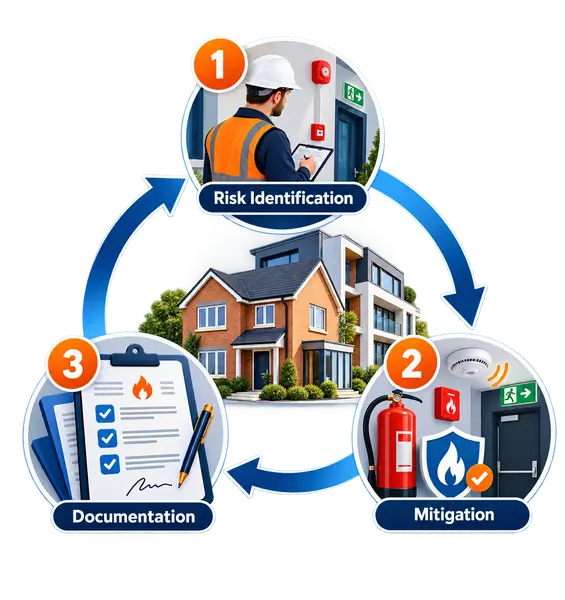
When conducting a fire risk assessment in London, we follow a structured process to ensure every detail is addressed.

Risk identification

The first stage is risk identification, where we systematically review all potential fire hazards within the property. This involves a close inspection of both the physical environment and the operational procedures in place. It is crucial to understand not only where risks originate but also how they interact with the building and its occupants.

Mitigation

Once risks have been identified, the next stage is mitigation. Here, we develop strategies to reduce or remove fire hazards. This may include modifying procedures, upgrading detection and suppression systems, or enhancing escape routes and signage.

Documentation

A key element of any fire risk assessment is thorough documentation. We carefully record all findings along with the reasoning behind each mitigation measure. This serves both as a legal safeguard and a strategic reference for future reviews and assessments.

Regulatory Compliance Review

Compliance With Regulations

By adhering to strict regulatory frameworks, our team continually reviews compliance to ensure every fire safety measure meets current legal standards. We recognise that risk mitigation is not just about following today’s rules, but also about anticipating future legislative changes. Our reviews are never superficial; they are thorough, systematic evaluations designed not only to maintain compliance but also to demonstrate proactive engagement with emerging standards.

Comprehensive Fire Hazard Identification

We carry out a thorough inspection of your property to identify potential sources of ignition, fuel, and oxygen that could increase fire risk.

Risk Evaluation for Occupants

Our assessors evaluate how a fire might affect different occupants, including vulnerable individuals or tenants with limited mobility.

Assessment of Fire Safety Measures

We review your existing fire safety measures including alarms, extinguishers, signage, lighting, and fire doors to confirm effectiveness and compliance.

Legal Compliance Assurance

We review your existing fire safety measures including alarms, extinguishers, signage, lighting, and fire doors to confirm effectiveness and compliance.

Deal for All Property Types

Whether you manage HMOs, blocks of flats, commercial premises, or mixed-use properties, our service is tailored to meet your building’s specific requirements.

Whether you manage HMOs, blocks of flats, commercial premises, or mixed-use properties, our service is tailored to meet your building’s specific requirements.

YOUR BOOKING CONTACT

People Behind Your Booking

Dure Shehvar – Sales and Support Executive

For booking questions, call 020 3386 1854 or Email us.

Meet the wider team at Landlord Certifications.

Assessment Options Compared

Professional Vs. DIY Assessments

Professional Assessments

Specialist Knowledge

Professionals have the expertise and experience that DIY checks typically lack.

Comprehensive Evaluation

A detailed assessment aligned with the latest regulatory requirements and best practices.

Accurate Risk Identification

Use of the right tools and training to identify hazards with precision.

Effective Mitigation Strategies

Clear, practical recommendations to improve safety and reduce risk.

Greater Reliability

Better compliance with building codes, fire safety standards and legal requirements.

DIY Assessments

Lower Initial Cost

DIY assessments may be cheaper upfront, but they can miss critical issues.

Limited Expertise

Lack of specialist knowledge can lead to overlooking important hazards.

Reduced Accuracy

Key risks may not be identified, affecting the overall reliability of the assessment.

Potential Consequences

Gaps in the assessment can result in fines, enforcement notices, or non-compliance.

Higher Long-Term Risk

May appear cost-effective, but can lead to greater safety risks and additional costs later.

Assessment Findings & Actions

What Happens If the Assessor Finds Problems?

A fire risk assessment identifies risks and recommended actions. The responsible person must review be findings, agree priorities and act promptly on urgent issues. Ongoing checks and maintenance remain essential.

Keep Assessment and Repair Costs Clear

Ask for an explanation of the finding and the outcome required before commissioning work. Where extra services are proposed, confirm the scope, price and completion evidence separately.

You can obtain quotations from other suitably competent contractors. Keep records of completed actions and share relevant changes with the person reviewing the FRA.

Our report-query and follow-up service: contact, support limits and any review-visit charge to be confirmed.

An FRA Is Different from an FRAEW or EWS1

A building FRA considers the wider fire-safety risks. An FRAEW is a specialist appraisal of external-wall fire risk that may be needed to inform the FRA. An EWS1 is a separate form used in property valuation and lending; it does not replace the building’s FRA.

If a lender, freeholder or managing agent asks for an FRAEW, EWS1 or specialist fire strategy, send us the exact request. A standard FRA booking does not include those documents.

Fire Safety Legislation

Is a Fire Risk Assessment Legally Required?

In England, the Regulatory Reform (Fire Safety) Order 2005 requires the responsible person to carry out a suitable and sufficient fire risk assessment and keep it under review. It applies to workplaces and relevant shared areas of residential buildings.

A single private dwelling is generally outside the Order, but separate housing and licensing duties may still apply. The building’s use and shared areas determine which rules apply.

Who Is Responsible?

The responsible person may be an employer, landlord, building owner or anyone with control of the premises. Where responsibilities are shared, dutyholders must cooperate. Appointing an assessor does not remove their legal duties.

What Are the Penalties?

Authorities can issue enforcement or prohibition notices. Serious fire safety offences can result in unlimited fines and up to two years' imprisonment. Purchasing a report does not prevent enforcement.

Keep Records and Act on the Findings

Responsible persons must keep a full record of the assessment and fire safety arrangements. The Fire Safety Act 2021 confirmed that, in buildings with two or more domestic premises, the Order covers the structure, external walls and flat entrance doors.

How Often Should It Be Reviewed?

There is no fixed annual expiry date for every fire risk assessment. It must be reviewed regularly and when significant changes occur. A review does not always mean a new assessment is needed.

Fire Safety Resources

Resources and Further Reading

To gain deeper insight into the complexities of fire risk assessment, a wide range of resources and literature is available, covering best practices, regulatory standards, and advanced methodologies. These materials are invaluable for building expertise and strengthening practical knowledge.

Online courses, in particular, provide structured learning pathways suitable for both beginners and experienced professionals. Platforms such as Coursera and Udemy offer modules that cover everything from the fundamentals of fire safety to advanced risk evaluation methods. Many of these courses also include real-world case studies, including examples from London properties, giving learners a practical understanding directly applicable to their work.

TRUSTED & ACCREDITED

Working to Recognised Safety Standards

We work with qualified professionals and follow recognised UK property safety and compliance standards.

FREQUENTLY ASKED QUESTIONS

Fire Risk Assessment FAQs

Do I need a fire risk assessment for a rented house or flat

It depends on the premises. An ordinary single private dwelling is generally outside the Fire Safety Order, while relevant shared parts, workplaces and paying-guest accommodation are treated differently. Other housing or licensing duties can still apply. Tell us how the property is used.

How much does a fire risk assessment cost?

he price depends on the building use, size, height, layout, access and assessment extent. Check the price table and confirm the final total, VAT and exclusions. A bedroom count alone may not establish the correct scope.

Can I do the assessment myself?

Only if you have the knowledge and ability to produce a suitable and sufficient assessment for
those premises. Complex buildings need appropriate specialist expertise. Appointing help does
not remove the responsible person’s duties.

How long does the visit take, and when will the report arrive?

Both depend on the building and scope. Confirm the estimated visit duration and expected report-delivery time separately before booking. Tell us about any council, agent or insurer deadline.

Will the assessor need access inside every flat?

Not necessarily. Access depends on the agreed assessment extent and the building’s needs. Confirm it beforehand, including any flat-door access. Unavailable areas or documents may create limitations or require a further visit.

What are Type 1, Type 2, Type 3 and Type 4 assessments?

These terms distinguish assessment extent and whether intrusive investigation or areas inside flats are included. Send the exact request so the appropriate scope can be confirmed. Do not assume a standard booking covers every type.

Does an FRA include an FRAEW, EWS1 or evacuation plan?

A standard FRA does not automatically include these separate services or documents. It may identify the need for specialist work. Share the original request and confirm what is included before booking.

What happens if the report identifies serious problems?

The responsible person must arrange appropriate action and follow the stated urgency. Seek clarification promptly and keep evidence of completed work. You can obtain quotations from other suitably competent contractors.

How often must a fire risk assessment be reviewed?

Review it regularly, when it may no longer be valid and after significant changes. Follow the building-specific recommendation. There is no single statutory annual expiry date applying to every FRA.

Who arranges the FRA for a block of flats?

The responsible person is often the building owner, freeholder or managing agent, depending on control and arrangements. If you own one flat, ask for the existing building assessment before commissioning a duplicate. Several parties can have duties.

What will I receive?

You receive the agreed written assessment, including its scope, findings, limitations and action
plan. Confirm the report format, delivery time and any follow-up support in your quotation.

Do you cover my area or offer urgent appointments?

Send the postcode, building details and required date. We will check suitability and availability. Same-day attendance or report delivery is not guaranteed unless specifically confirmed.

Is an FRA the same as a fire safety certificate?

No. An FRA records the building’s assessed risks and actions. Certificates or records for individual systems do not replace that assessment. Check exactly which document your council, agent or insurer has requested.

Does the assessment include repairs, alarm tests or detailed fire-door surveys?

Not unless the quotation expressly includes them. The assessor considers relevant precautions, but servicing, testing, specialist surveys and repair work may need separate appointments and prices.

Will the report guarantee council, insurer or lender acceptance?

No universal acceptance guarantee is possible. Share their written requirements before booking so scope can be checked. They may require additional evidence or action after the assessment.

Assessment Booking

Arrange Your Fire Risk Assessment

Tell us about your building, confirm the assessment scope and price, then arrange a visit.

RELATED SERVICES

Related Fire-Safety Services

Need other checks for the same property? View our Gas Safety Certificates, Energy Performance Certificates, Fire Risk Assessments and PAT testing services. Each service has its own scope and booking requirements.

Online Booking

[forminator_form id="2335"]

Online Booking

[forminator_form id="2336"]

Online Booking

[forminator_form id="2337"]

Online Booking

[forminator_form id="2338"]

Online Booking

[forminator_form id="2339"]

Online Booking

[forminator_form id="2340"]

Online Booking

[forminator_form id="2341"]

Online Booking

[forminator_form id="2305"]

Online Booking

[forminator_form id="2306"]

Online Booking

[forminator_form id="2307"]

Online Booking

[forminator_form id="2308"]

Online Booking

[forminator_form id="2309"]

Online Booking

[forminator_form id="2310"]

Online Booking

[forminator_form id="2311"]

Online Booking

[forminator_form id="2304"]