PAS 79 provides UK property owners with a clear, standardised method for assessing and recording fire risks in residential and mixed‑use buildings. It aligns with the Regulatory Reform (Fire Safety) Order 2005 and defines scope, inspection steps, risk estimation and prioritised remedial actions. Templates guarantee traceable reports, action plans, maintenance records and handover packs. The approach helps meet inspector expectations and protects vulnerable occupants while retaining owner control. Further sections explain practical checks, common defects and implementation steps.
Key Takeaways
- PAS 79 provides a standardised framework and templates for conducting and recording compliant fire risk assessments in UK residential and mixed-use buildings.
- Begin with scoping premises, occupancy, vulnerable groups, and applicable legislation to define assessment boundaries and responsibilities.
- Systematically identify hazards, evaluate likelihood and consequence, and prioritise remedial actions with realistic timescales and accountable owners.
- Use PAS 79 reporting to document existing controls, risk ratings, recommended measures, maintenance records, and review dates for inspector scrutiny.
- Handover a concise file: executive summary, full report, action plan, evidence, and procedures for ongoing monitoring, training, and periodic reviews.
Table of Contents
Who This Guide Is For and How to Use It
This guide is intended for UK property owners, landlords, managing agents, and responsible persons who must identify and manage fire risks in residential and mixed-use buildings; it explains legal obligations, practical assessment steps, and recommended mitigation measures, enabling readers to carry out or commission compliant, proportionate fire risk assessments. It addresses those who value autonomy in property management, offering clear criteria to judge when to act and when to instruct competent professionals. The text outlines typical building types, common hazards, and roles and responsibilities without prescribing unnecessary state control; it highlights evidence-based decision points to support informed choices. Users are shown how to prioritise interventions, document findings, and review assessments periodically or after changes. Templates and checklists are presented for pragmatic application, enabling efficient, repeatable practice. The tone remains neutral and empowering: readers retain control while meeting safety and legal standards, reducing uncertainty and enabling confident, proportionate risk management.
PAS 79 Explained: Scope and Legal Context
PAS 79 provides a standardised framework for conducting and recording fire risk assessments, clarifying scope, methodology and documentation requirements to guarantee consistency and defensibility of findings. It outlines applicability across building types, aligns with the Regulatory Reform (Fire Safety) Order 2005 duties, and guides responsible persons on establishing proportionate measures without overreach. The standard defines boundaries of assessment, expected records, and the relationship between professional judgment and statutory obligations.
- Applicability: scope covers non-domestic premises and common parts of residential blocks, allowing owners to know when PAS 79 is relevant.
- Legal alignment: supports compliance with UK fire safety law by documenting risk-based decisions.
- Documentation: prescribes formats and content needed to defend actions to regulators or insurers.
- Professional role: clarifies expectations for competent assessors while permitting property owners freedom to choose competent approaches.
The tone remains practical, empowering owners to act within legal constraints while preserving operational autonomy. Here is the Fire Safety Regulations and Fire Risk Assessment Explained Clearly
Step‑by‑Step PAS 79 Assessment
A clear, methodical sequence guides assessors through a PAS 79 fire risk assessment, beginning with scoping and moving through inspection, hazard evaluation, risk estimation, recording findings and recommending controls. The assessor first defines premises, occupancy and relevant legislation, keeping scope proportional to purpose. A systematic inspection follows: identify ignition sources, combustible materials, occupants at risk and existing fire protection measures. Each hazard is evaluated for likelihood and consequence, noting vulnerable groups and periods of increased exposure. Risk estimation combines these factors to prioritise issues requiring action. Practical, proportionate measures are recommended to reduce risk, ranging from housekeeping and detection to means of escape and staff training. Findings are documented clearly, with rationale, priority ratings and timescales for completion. The process ends with review arrangements and triggers for reassessment. Throughout, the approach balances regulatory compliance with pragmatic choices that preserve operational freedom while protecting people and property.
Using PAS 79 Templates & the Standard Report
When completed consistently, PAS 79 templates guide assessors through a standard report structure that guarantees legal compliance, clear risk prioritisation and straightforward communication with dutyholders. The template frames findings, assigns responsibilities, and timestamps actions so owners retain control and transparency. It encourages concise evidence, photographic references, and measured judgment rather than opinion.
A standard report typically contains:
- Executive summary highlighting key risks and immediate actions.
- Detailed hazard descriptions, existing controls, and risk ratings.
- Recommended remedial measures with prioritisation, responsible parties, and deadlines.
- Record of checks, maintenance needs, and review dates to sustain freedom from uncertainty.
Templates free assessors from reinventing format, enabling focus on practical solutions and tenant safety. They guarantee consistency across properties, simplify audits, and support defensible decisions. Users can adapt language to reflect local arrangements while preserving the core structure required for legal and operational clarity.
Quick PAS 79 Checklist: When You Need One
Why is a condensed PAS 79 checklist useful for busy property owners? A short checklist offers a focused, actionable snapshot of fire-safety priorities, facilitating swift decisions and preserving time for freedom-focused tasks. It highlights triggers for a full assessment and immediate controls, guiding owners who prefer efficient, autonomous management.
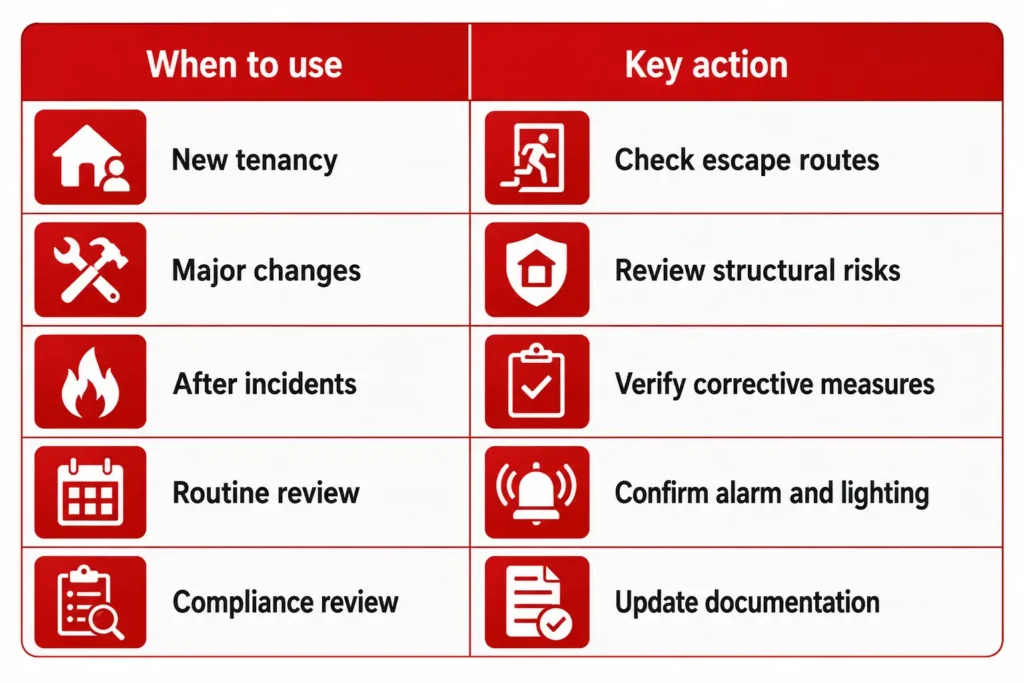
The checklist is not a substitute for a full PAS 79 report but a practical tool: confirm alarms and signage, guarantee clear exits, assess means of warning, spot combustible storage, and record simple mitigations. It helps owners decide whether to engage specialists or implement quick fixes themselves. Clear, portable, and decisive, the condensed checklist supports property owners who value autonomy and want to keep safety manageable without sacrificing control.
Common PAS 79 Defects and Practical Fixes
Many common PAS 79 defects recur across UK properties, and identifying them quickly permits targeted, cost-effective fixes. A detached review highlights frequent issues and straightforward remedies that restore safety without onerous constraints.
- Blocked escape routes — clear corridors, remove stored items, fit simple signage and lighting to preserve unimpeded egress.
- Faulty or missing fire doors — repair hinges, seals and closers; replace non-compliant doors to reinstate compartmentation.
- Inadequate detection/alarm systems — test, replace expired detectors, and guarantee audible coverage for all occupancies.
- Poorly maintained electrical installations — arrange PAT testing, fix overloaded sockets, and isolate unsafe circuits promptly.
Each defect is paired with pragmatic actions: prioritise high-risk areas, schedule modest repairs, and use competent contractors when needed. The emphasis remains on practical freedom, enabling owners to act decisively, minimise disruption, and regain compliant, safer premises with clear, affordable steps.
Legal Duties, Record Keeping & Inspector Expectations
Addressing common PAS 79 defects is only part of the obligation: property owners must also meet statutory duties, maintain clear records, and be prepared for inspector scrutiny. The owner should guarantee compliance with the Regulatory Reform (Fire Safety) Order 2005, appointing responsible persons and implementing proportionate measures that enable occupants to live and operate freely within safe premises. Record keeping must be systematic: documented risk assessments, action plans, maintenance logs, training records, and evacuation drills should be readily accessible and concise. Records function as evidence of due diligence and support swift corrective action without imposing unnecessary bureaucracy. Inspectors expect accuracy, traceability, and prompt responses to identified issues; they value clear responsibilities, realistic timescales, and demonstrable follow-through. Transparent documentation and cooperative engagement reduce enforcement risk and preserve autonomy. Owners who balance legal duty with pragmatic record management satisfy inspectors while protecting occupants and retaining operational freedom.

Reviewing, Updating and Handing Over PAS 79 Assessments
Reviewing and updating PAS 79 assessments guarantees that fire risk evaluations remain accurate, actionable and aligned with changing use, occupancy or legislation. The assessor schedules periodic reviews and triggers updates after alterations, incidents or regulatory changes. Documentation is amended to reflect new findings; responsibilities and timescales are reassigned where needed. Clear handover protocols enable owners to retain control and freedom to act.
- Record review frequency and reasons for change.
- Update hazard identification, risk ratings and remedial actions.
- Communicate revised responsibilities to dutyholders and occupants.
- Archive previous assessments with version control for accountability.
When handing over, the assessor provides a concise file: summary, full report, action plan and evidence. Ownership receives guidance on monitoring, training and sign-off procedures that preserve autonomy while meeting legal obligations. The process prioritises simple, decisive steps so property owners can implement recommendations without delay, maintain compliance and confidently manage future reviews.
Frequently Asked Questions
How Much Does a Professional PAS 79 Assessment Typically Cost?
Typically £150–£800 depending on premises size, complexity, and assessor expertise. The individual seeking autonomy reviews quotes, negotiates scope, and selects firms offering transparent fees, clear reports, and optional follow-up support to retain control.
Can PAS 79 Cover Temporary Event Venues and Marquees?
Yes. They cover temporary event venues and marquees, evaluating fire hazards, means of escape, emergency planning, and temporary installations. The assessor balances regulatory duty with organisers’ autonomy, advising proportionate controls and practical risk-reduction measures.
Are PAS 79 Reports Accepted by Insurers as Compliant Documentation?
Yes; many insurers accept PAS 79 reports as compliant documentation, provided the assessment is thorough, up-to-date and evidence-backed. Insurers retain discretion, so policyholders should confirm specific requirements and any additional insurer-imposed standards beforehand.
Do Electronic PAS 79 Templates Meet UK Regulatory Evidence Requirements?
Yes. They can meet UK regulatory evidence requirements if complete, auditable and retained securely; the assessor guarantees accuracy, signatures (electronic/validated) and version control, demonstrating compliance and enabling freedom for efficient, paperless fire-risk management.
Can Tenants Commission PAS 79 Assessments Without Landlord Consent?
No. Tenants cannot unilaterally commission assessments affecting shared or structural areas without consent; they may arrange inspections within their own demised premises, but doing otherwise typically requires landlord approval or legal remedy.
Conclusion
This guide equips UK property owners with a concise, practical roadmap for conducting PAS 79 fire risk assessments. It clarifies who should use the standard, explains the legal context, outlines step‑by‑step assessment procedures and templates, and highlights common defects and their remedial actions. Emphasis is placed on accurate recording, statutory duties, inspector expectations, and timely review. Properly applied, PAS 79 supports clear, defensible decisions that reduce fire risk and demonstrate regulatory compliance.