How to Wire a Garage Consumer Unit. A qualified electrician must verify isolation and permissions and select appropriate cables, breakers, and RCD/RCBO protection before starting work. They plan dedicated circuits for lighting, sockets, fixed equipment, and EV chargers, size conductors to the load, and route the supply into a correctly earthed enclosure. Neutrals and earths are dressed first, lives connected after checks, and full continuity, polarity and RCD tests are recorded. Follow BS 7671 compliance and retain certification for handover, with further guidance available below.
Key Takeaways
- Isolate supply, obtain necessary permissions, and confirm compliance with BS 7671 before starting any consumer unit work.
- Plan circuits and load calculations, selecting correct cable sizes and a dedicated 32A single-phase or 40A three-phase feed.
- Fit an appropriate RCD/RCBO or dedicated EV protection device and provide RCD protection where required.
- Dress and terminate earths and neutrals first, then connect lives, clearly label all circuits, and provide an as-installed schematic.
- Perform full testing: continuity, insulation resistance, polarity, and RCD trip tests; record results and issue certification.
Table of Contents
Quick Answer: Wiring Steps Checklist for a Garage Consumer Unit
A concise checklist outlines the essential steps for wiring a garage consumer unit: verify supply isolation and permit, plan circuits and load calculations, select appropriate cable types and protective devices, install the enclosure and earth/neutral arrangements, route and terminate conductors with correct labeling, fit RCDs/MCBs and test continuity and polarity, and complete commissioning with test records.
The practitioner assesses required radial and ring circuits, designates dedicated supplies for heavy equipment, and balances loads to avoid nuisance trips. Cable selection follows current ratings and installation method, while protective devices are chosen for discrimination and selectivity. Positioning of the consumer unit considers access and future expansion.
Earthing and bonding are arranged to maintain equipotential continuity. Conductors are routed neatly, secured, and terminated to specified torque values with clear labeling for each circuit. Final checks include insulation resistance, earth loop impedance, and RCD trip times before documenting certificates and test results for owner autonomy and future modifications.

UK Legal and Safety Must‑Haves Before You Start
Why check regulations and permissions before touching any wiring? The guide states that compliance prevents danger, legal penalties, and insurance voidance. UK electrical work often requires notification to building control or registration via a competent person scheme; confirming whether the planned garage work falls within permitted scope is essential. Only persons with appropriate qualifications should carry out or certify certain tasks.
Safety equipment, RCD protection, correct cable types, and earthing arrangements must meet BS 7671 standards; the installer must verify the applicable edition and amendments. Local planning or listed‑building restrictions can impose additional constraints. Portable appliance testing and final certification protocols affect occupancy and insurance. Records, test results, and certificates should be retained.
This section emphasises informed autonomy: freedom to upgrade a garage responsibly comes with observing mandatory safeguards. Knowing obligations upfront preserves personal liberty while protecting occupants and property from electrical risk and regulatory consequences.
Step‑by‑Step Wiring Sequence and Best Practices
Before any conductor is terminated, the installer should develop a clear wiring sequence that lists circuits, protective devices, cable routes, and isolation points; this plan guides safe, efficient execution and simplifies future testing and maintenance. The installer then follows a disciplined order: isolate supply, route and secure cables, terminate neutrals and earths, connect live conductors last, and label each circuit. Attention to segregation, bending radii and support intervals preserves longevity and safety.
- Verify isolation and prove dead before working.
- Run and fix cables with correct clips and spacing.
- Dress neutrals and earths to their designated bars first.
- Connect live conductors after mechanical and continuity checks.
- Label all terminals and record the as‑installed schematic.
This approach enables autonomy: a clear sequence reduces mistakes, supports independent inspection, and allows straightforward future modifications. Practical checks continuity, polarity, and insulation resistance complete the process before re-energising.
Choose a Garage Consumer Unit, MCBs and RCD/RCBOs
When selecting a garage consumer unit, the installer should prioritize protective device coordination, an appropriate enclosure rating, and clear segregation of circuits to ensure both safety and compliance. The unit must accommodate the required MCB types (B, C, or D curves, as appropriate) and provide space for RCDs or RCBOs to enable selective protection: dedicated RCBOs for individual circuits where continued autonomy is desired, or a combination of RCD protection with MCB discrimination where simplicity and cost matter.
How to Wire a Garage Consumer Unit.IP rating and material should suit the garage environment; choose metal or robust plastic enclosures with at least IP43 for internal garages or higher for exposed locations. Labelling, clear neutral/earth bar segregation, and sufficient spare ways support future freedom to modify circuits. Verify devices are reputable, correctly rated for prospective fault conditions, and compatible with each other to avoid unwanted tripping. Documentation of chosen protective arrangements and their tested operation completes the selection process.
Supply Route, Cable Type, Isolation and Overcurrent Protection
A clear, secure supply route from the main distribution board to the garage consumer unit minimises voltage drop and mechanical risk while ensuring compliance with cable derating and protection rules. The route should be direct, accessible for inspection, and avoid hot or damp areas; fixed containment like conduit or PVC trunking is preferred to protect cable and allow future changes. Cable type must suit installation, typically 2.5 mm² for lighting, 6 mm² or 10 mm² for radial or strip heater circuits, and appropriately sized SWA or PVC-SWA for the final circuit into the consumer unit selected to match load, length and derating factors.
- Determine the length and calculate the voltage drop before selecting the conductor size.
- Choose an armoured cable where mechanical protection or external runs are required.
- Fit an isolator at the garage consumer unit entry, labelled and accessible
- Coordinate overcurrent protection to cable rating; avoid nuisance trips
- Use MCB/RCD or RCBO combinations to protect against overloads and earth faults
Earthing and Bonding: What to Fit and Why
Several key earthing and bonding measures are essential to guarantee safety in a garage consumer unit: a reliable earth connection to the main distribution board, a local earth electrode where required by regulations, and protective bonding of extraneous-conductive-parts such as gas pipes or metalwork. The guidance emphasises using appropriate earthing arrangements, PME (TN-C-S) continuity to the consumer unit or a TT arrangement with a dedicated earth rod if supply conditions demand and ensuring conductor sizes meet fault current and earth loop impedance requirements.
Protective bonding links incoming metallic services and structural steelwork to the earthing system to prevent dangerous potential differences. Main and supplementary bonding conductors must be routed securely, clearly labelled, and terminated with corrosion‑resistant fittings. RCD protection complements bonding by providing fault current detection where full equipotential bonding cannot be achieved. Documentation of earth tests, loop impedance, and bonding integrity is necessary to confirm compliance and preserve the freedom of safe, independent use of the garage space.
Design Circuits: Lighting, Sockets, Fixed Kit and EV Charging (Domestic)
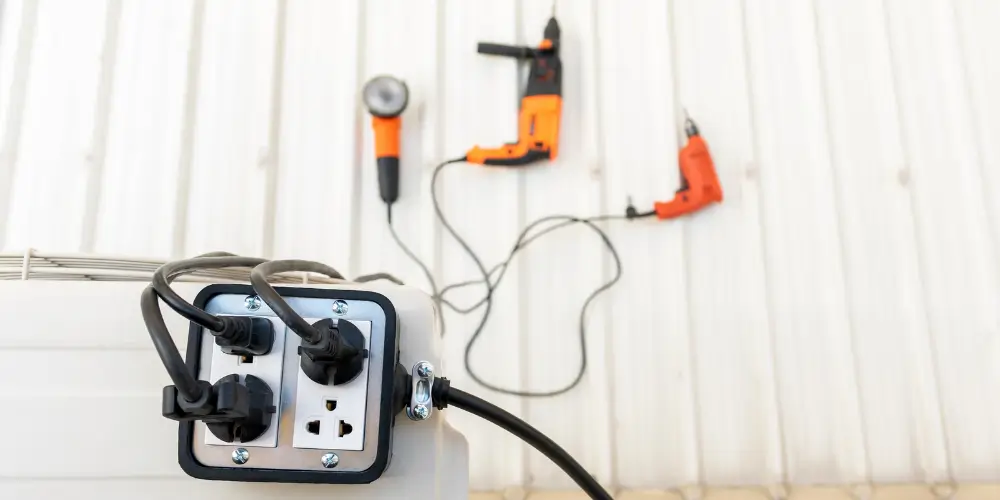
Circuit design for a garage consumer unit must balance load requirements, safety, and future flexibility by allocating dedicated circuits for lighting, general sockets, fixed appliances, and EV charging where applicable. The designer specifies circuit ratings, protective devices, and cable sizes to match expected loads while leaving capacity for expansion. Lighting often uses a 6A or 10A radial with 1.0–1.5 mm² cable, keeping emergency or external fittings on separate protected circuits. General-purpose sockets typically run on a 16A or 32A radial with 2.5 mm² cable and RCD protection for power tool use. Fixed appliances such as heaters, extractors or freezers require dedicated breakers sized to nameplate currents. Domestic EV charging mandates a dedicated 32A single-phase or 40A three-phase circuit, appropriate cable, and an RCD/RCBO or dedicated EV protection device.
- assign dedicated circuits for high-demand items
- guarantee RCD/RCBO protection where required
- size conductors for continuous load
- Plan spare ways in the consumer unit
- document circuit identification and labels
Testing, Commissioning and Common Faults to Check
Begin testing and commissioning with a structured sequence that verifies protective devices, continuity, polarity, insulation resistance, and operation of RCDs/RCBOs under realistic load conditions. The technician confirms correct circuit labelling, performs earth loop and prospective fault current checks, and documents results to enable independent freedom of inspection.
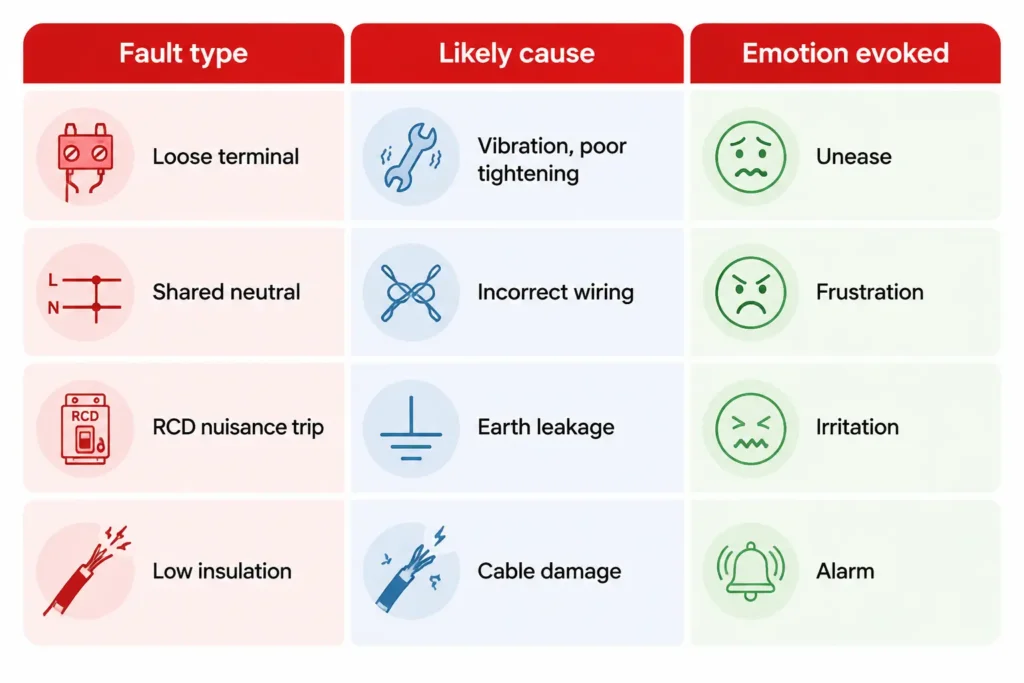
Routine tests expose wiring mistakes early: swapped neutrals, shared neutrals, poor terminations, and inadequate bonding. RCD trip times and thresholds are recorded; any marginal readings prompt corrective action before handover. Common faults to check include loose connections, overloaded ring circuits, damaged insulation, and incorrect consumer unit configuration. Final commissioning delivers a safe, reliable installation and empowers the owner with clear certificates and concise safety advice.
Frequently Asked Questions
Can I Install a Garage Consumer Unit Outdoors or in an Unheated Shed?
No, they should not. He prefers freedom but must follow regulations: consumer units need protection from weather, condensation and freezing, so install in a dry, ventilated, heated or insulated space indoors, meeting local electrical codes.
What Insurance Implications Arise From DIY Garage Electrical Work?
DIY garage electrical work can void policies or reduce claims if not certified; insurers may demand evidence of a registered electrician, charge higher premiums, or refuse liability for damage or injury caused by non-compliant installations, increasing financial risk.
How Do I Future‑Proof the Unit for Solar PV or Battery Connection?
Specify extra capacity, install an additional spare way with adequate space, fit an isolator and a DC/AC-ready enclosure, ensure earthing and RCD arrangements accommodate generation, and document inverter isolation and export control for seamless solar or battery integration.
Are Wireless Smart Breakers or Remote Monitoring Compatible With Consumer Units?
Yes. They can integrate, but compatibility depends on breaker type, DIN-rail space, neutral/earth arrangements, and RCD setup; a qualified electrician should verify system ratings, communications standards, and regulatory compliance before installation to preserve freedom and safety.
Can I Share a Garage Circuit With My House Under a Single MCCB?
They can, but it poses noncompliance and safety risks: sharing a garage and a house under one MCCB often violates regulations requiring separate protection and RCDs. A qualified electrician should assess and implement compliant segregation.
Conclusion
In conclusion, How to Wire a Garage Consumer Unit.careful planning, correct component selection and adherence to UK regulations guarantee that a garage consumer unit functions safely and reliably. Competent persons should assess supply routes, cable types, protective devices and earthing arrangements before work begins. Install RCD/RCBO protection, correct MCB sizing and appropriate bonding, then follow a methodical wiring sequence. Thorough testing and commissioning identify faults early. When in doubt or for non‑routine installations, engage a qualified electrician to certify compliance and safety.