A 14‑way consumer unit centralizes and segregates up to 14 circuits for homes or small businesses that need expanded distribution and future growth. It typically locates the incoming supply and main switch at one end, with busbars feeding labeled ways and neutral/earth termination bars beneath. Configurations use RCBOs, MCBs, RCDs, and surge protection to protect lighting, sockets, kitchen,n and heavy loads while meeting BS 7671. It simplifies troubleshooting, supports expansion, and offers clear benefits; continue for full details.
Key Takeaways
- A 14-way consumer unit distributes the incoming supply to 14 protected circuits for organised, expandable home or small-business electrical management.
- It houses RCBOs, MCBs, RCDs, and surge protection to provide individual overcurrent and earth-fault protection per circuit.
- Typical layouts group lighting, sockets, heating, and kitchen zones, with neutral and earth bars to ensure clear circuit segregation.
- Benefits include improved safety, easier fault isolation, future expansion capacity, and compatibility with smart-breaker or renewable integrations.
- Proper design follows BS 7671, uses correct cable sizes, bonding, labeling, and routine testing to ensure compliance and reliable operation.
Table of Contents
Who Needs a 14‑Way Consumer Unit?
Who requires a 14‑way consumer unit? A homeowner or small-business operator seeking extensive circuit segregation without relying on multiple smaller units often chooses a 14‑way consumer unit. It suits properties with many dedicated needs: extensive lighting schemes, multiple ring and radial circuits, separate heating and hot-water supplies, EV charging provision, and numerous appliance or workshop circuits. Landlords managing multi-occupancy houses benefit from the clear allocation of circuits per room or tenancy, aiding maintenance flexibility and the separation of responsibilities. Installers and designers select it where future expansion or smart-home integration is anticipated, reducing later disruption.
Remote properties aiming for self-reliance, solar arrays, battery storage, and isolated generation gain centralised control while keeping circuits distinct. The unit appeals to those who value autonomy, offering tailored protection and straightforward upgrades. It is not for minimal installations; its advantage lies in organization, capacity, and the flexibility to accommodate evolving electrical demands without extensive rewiring.
Typical Single‑Line Layouts for 14‑Way Units
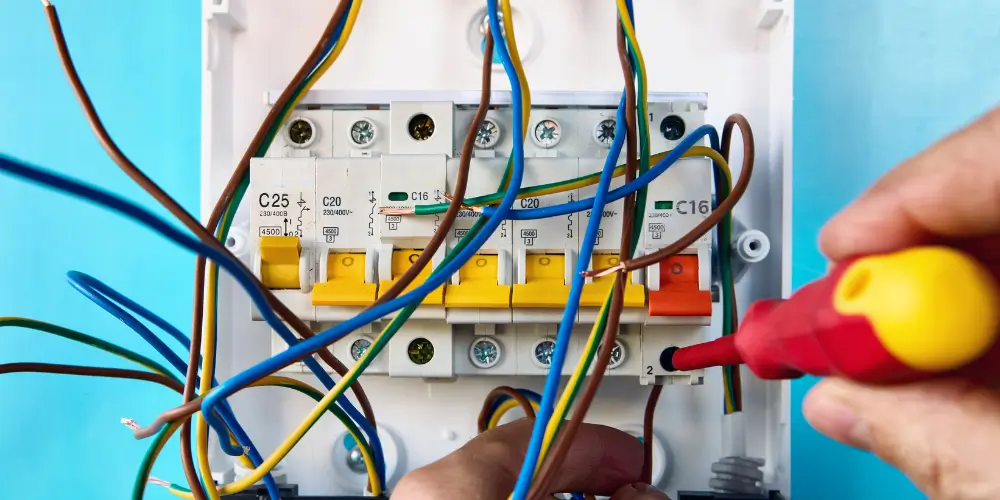
Having established why larger installations opt for a 14‑way consumer unit, attention turns to how those circuits are arranged on a single‑line diagram. Typical single‑line layouts prioritise clarity and flexibility: the incoming supply and main switch appear at the left, followed by a clear busbar representation feeding 14 outgoing ways. Circuits are grouped logically: lighting, general sockets, kitchen circuits, heating, and dedicated heavy loads, with spacing that allows easy identification and future additions.
Protective devices are shown inline with each way; neutral and earth termination bars are depicted beneath the outgoing feeders to indicate common return paths. Labels and circuit numbers are placed consistently to support rapid modification and fault isolation. Diagrams often include spare ways and reserved labeling for expansion, reflecting a preference for adaptability. For users who value autonomy, these layouts enable informed decisions about load distribution, upgrades, and the practical layout of wiring routes without obscuring operational relationships.
14‑Way Unit Components: RCBOs, MCBs, RCDs, Surge Protection
A 14‑way consumer unit integrates a mix of protective devices RCBOs, MCBs, RCDs, and surge protection to deliver individualised circuit protection, fault discrimination, and system resilience. RCBOs combine overcurrent and earth-fault protection per circuit, enabling selective isolation without disrupting unrelated circuits; they suit high-value or safety‑critical feeds where autonomy is prized. MCBs provide compact, reliable overcurrent protection for lighting and general circuits, chosen by curve and rating to match conductor and load characteristics. RCDs offer residual-current protection for groups of circuits, guarding against earth leakage and electrocution risk;
They are specified by sensitivity (30 mA common for personal protection) and response time. Surge protection devices (SPDs) mitigate transient overvoltages from lightning or switching, preserving sensitive electronics and extending equipment life. Proper coordination matching trip characteristics, discrimination hierarchy, and SPD placement ensures maximum availability and safety while allowing occupants freedom to use circuits independently and confidently.
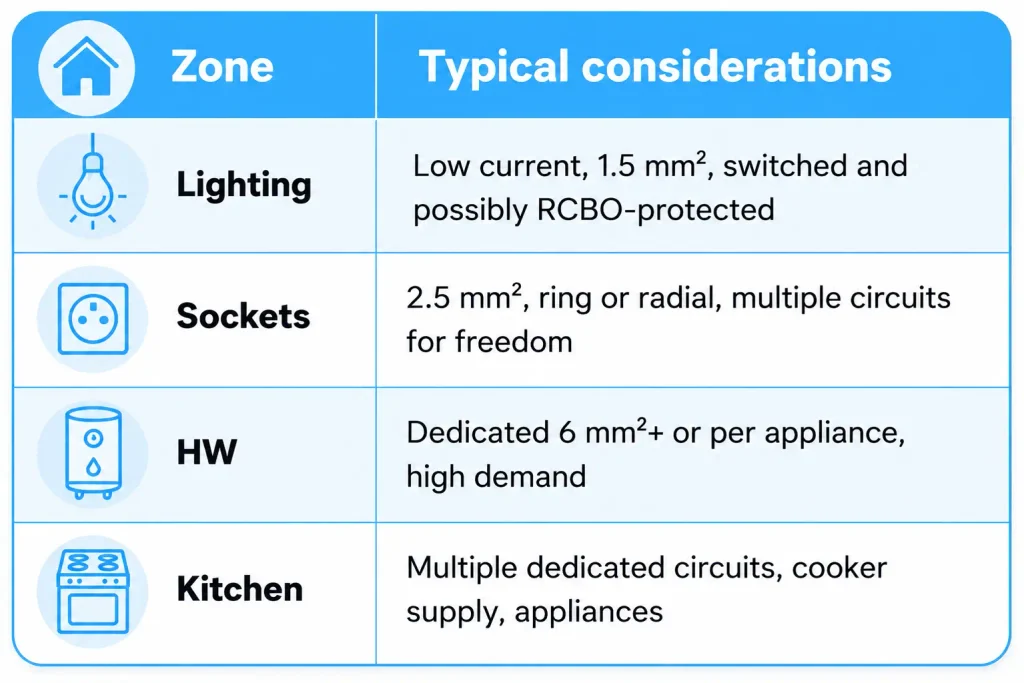
Planning Circuits: Lighting, Sockets, HW, and Kitchen Zones
With the protective devices and discrimination strategy in place, circuit planning then assigns loads into functional zones lighting, general sockets, hot water (HW), and kitchen so protection, conductor sizing, and switchgear align with usage patterns and safety requirements. The planner separates high-demand kitchen and HW circuits from general-purpose sockets and lighting to preserve continuity, simplify fault isolation, and allow user autonomy. Cable sizes match load and run length; isolation and dedicated breakers prevent nuisance trips. Zones reflect lifestyle choices: flexible socket circuits for versatile living spaces, ring or radial layouts to suit preference, and dedicated HW and cooker lines for predictable supply. Documentation labels each zone for straightforward future changes.
Safety and Compliance: BS 7671, Earth Faults, and Testing
Compliance with BS 7671 governs the design, earthing arrangements, and protective measures required to manage earth faults and ensure safe operation; it mandates the selection of protective devices, correct earthing and bonding, and verification testing to confirm that fault currents are contained and that disconnection times meet specified limits. The consumer unit must support compliant protective device coordination, clear identification of protective conductors, and accessibility for testing. Routine inspection and testing verify continuity of earth paths, correct polarity, insulation resistance, and RCD trip times so that faults do not place occupants at risk.
- Protective device choice: correct MCB/RCD types and settings for discrimination and rapid disconnection.
- Earthing and bonding: solid connections, earth electrode or TN/TT arrangement, and equipotential bonding where required.
- Testing regime: continuity, insulation resistance, earth loop impedance, and RCD operation, recorded in accordance with standards.
Documentation of results and adherence to BS 7671 enable freedom of use while ensuring safety and legal compliance without compromising functionality.
Installation Scenarios: New Builds, Upgrades, and Split‑Property Use
Design considerations differ markedly between new builds, upgrades, and split‑property conversions, each presenting distinct requirements for consumer unit selection, location, and protective coordination. In new builds, planners can specify a consumer unit to match load diversity and future flexibility, placing it for easy access and routing. Circuit grouping, spare ways, and space for RCD/RCBO arrangements are chosen to support independent zones and tenant autonomy.
Upgrades in existing properties require assessment of existing wiring, available voids, and regulatory retrofitting to meet current BS 7671 requirements without unnecessary disruption. Choices balance minimally invasive work with improved protective devices and load capacity.
Split‑property conversions demand segregation of supplies, metering arrangements, and clear earth/neutral separations to prevent cross‑feed. Independent consumer units or sub‑boards are often installed with coordinated protection and labels to preserve occupant freedom to manage their own circuits. All scenarios benefit from planning that prioritises accessibility, compliance, and future adaptability.
Troubleshooting 14‑Way Consumer Units
Troubleshooting a 14‑way consumer unit requires a methodical approach that isolates faults, verifies protective device operation, and confirms wiring integrity across all ways. The process begins with a visual inspection for signs of damage, loose connections, or overheating. Record which way corresponds to which circuit, then operate each protective device to check trip behavior and reset functions. Use an insulation tester and continuity checks to confirm circuit integrity without assuming labelling accuracy. Where RCDs or RCBOs are present, test their trips under load conditions and confirm nuisance tripping causes, such as shared neutrals or earth faults.
- Verify labeling and mapping of all 14 ways, correcting discrepancies.
- Systematically isolate and test each circuit with appropriate instruments.
- Investigate intermittent faults by recreating load conditions and monitoring.
Documentation of findings and clear recommissioning after repairs preserves safety and supports freedom to adapt circuits later. If uncertainty remains, consult a competent electrician rather than continuing intrusive testing.
Costs, Benefits, and Future Proofing a 14‑Way Unit
Having completed fault isolation and verification, attention turns to the costs, benefits, and futureproofing of a 14‑way consumer unit. Costs include purchase, installation, and potential upgrades; benefits are circuit control, safety, and expansion capacity. Future Proofing considerations favor modular designs, spare ways, and compatibility with smart breakers and renewable energy inputs. The individual weighs initial expense against long-term autonomy and reduced retrofit disruption.
| Item | Short-term impact | Long-term freedom |
| Purchase price | Moderate | Enables planned growth |
| Installation | Professional cost | Minimizes future work |
| Spare ways | Slight extra cost | Simplifies additions |
For those who value independence, the 14‑way unit balances predictable upfront investment with the freedom to adapt electrical systems. Choosing quality components and planning for smart integration preserves options, reduces dependency on invasive upgrades, and supports evolving energy choices without repeating major expenses. Here you can find the cost factors: Cost of Installing a Consumer Unit : What to Expect in the UK
Frequently Asked Questions
Can a 14‑Way Consumer Unit Be Used in Commercial Premises?
Yes. They can, provided the 14‑way consumer unit meets commercial electrical regulations, is properly rated, installed by a qualified electrician, and accommodates required circuits, protections, and future expansion; the installer assumes responsibility for compliance and safety.
How Long Does a Typical Warranty for Consumer Units Last?
Typical warranties for consumer units commonly span one to ten years, though most manufacturers offer three to five years. The purchaser should verify the terms, coverage limits, and registration requirements to preserve rights and maintain freedom of installation.
Are Smart Metering or Home Automation Integrations Supported?
Yes, the unit supports smart metering and home automation integrations; the installer configures compatible modules and protocols, allowing owners to retain control, choose interoperable devices, and adapt systems without vendor lock-in or unnecessary restrictions.
What Maintenance Intervals Are Recommended for Consumer Units?
They recommend inspection every 1–2 years and a full electrical test every 5–10 years; urgent checks are required after any faults or modifications. The owner values autonomy and may schedule trusted professionals on flexible, self-directed terms.
Can a 14‑Way Unit Reduce Insurance Premiums?
Yes, a 14‑way unit can lower premiums if it enhances safety and meets insurer requirements; the individual should document compliant installation, professional certification, and improved protection to persuade insurers to apply discounts for reduced electrical risk.
Conclusion
A 14‑way consumer unit offers extensive circuit distribution, combining RCBOs, MCBs, RCDs and surge protection to balance safety, compliance and flexibility. Suited to larger homes, split properties or futureproofed installations, it supports separate lighting, sockets, heating and kitchen zones while meeting BS 7671 requirements when properly installed and tested. Although costlier and more complex to plan, its granular protection simplifies troubleshooting and enhances fault isolation, making it a practical long‑term investment.