
How much does rewiring a house typically cost? In most U.S. markets, it’s $4,000–$15,000, while larger or higher-spec properties can exceed $20,000. Pricing depends on home size, circuit count, access to walls and floors, and whether the electrical panel needs to be upgraded. Permits, inspections, and utility coordination may add fees, and labour is usually the highest cost. Partial rewires can be cheaper when existing circuits are sound, and service size is adequate. More details follow below.
Key Takeaways
- Typical UK house rewiring costs range from $4,000 to $15,000, with larger or premium homes often exceeding $20,000.
- Full rewires are needed for unsafe wiring (knob-and-tube or aluminium) or major remodels; partial rewires cut costs when circuits are sound.
- Price depends on square footage, number of circuits/outlets, access difficulty, and whether the electrical panel/service capacity needs upgrading.
- Quotes should include itemised scope, permits/inspections, testing, code-compliance documentation, and clear assumptions about wall/floor access and repairs.
- Control costs by standardising specs across bids, avoiding vague provisional sums, and planning for future needs such as EV charging, exterior outlets, and data cabling.
Table of Contents
How Much Does It Cost to Rewire a House?
How much does it cost to rewire a house?
In most U.S. markets, homeowners typically see totals from about $4,000 to $15,000, with larger or higher-end properties reaching $20,000+. Price rises with square footage, number of circuits, panel capacity upgrades, local labour rates, and the difficulty of accessing walls, attics, and crawlspaces.
Labour often accounts for the largest share, followed by materials such as copper wire, breakers, boxes, and required safety devices, such as AFCI/GFCI protection. Permits, inspections, and utility coordination can incur significant fees, but they also help ensure long-term independence by ensuring the work is legal and insurable.
Costs also increase when the job includes opening and repairing finishes, upgrading grounding and bonding, replacing outdated service equipment, or bringing kitchen and bath circuits up to modern code. Getting itemised bids helps compare scope, not slogans.

Do You Need a Full Rewire or a Partial Rewire?
Whether a home needs a full rewire or a partial rewire depends on the condition and type of existing wiring, the capacity of the electrical service, and the scope of planned upgrades.
A full rewire is typically warranted when the wiring is obsolete or unsafe, such as knob-and-tube wiring, aluminium branch circuits, brittle insulation, frequent tripping, overheated outlets, or widespread ungrounded circuits. It also makes sense when walls will be opened for major remodelling, allowing a clean reset of circuits, grounding, and modern protections throughout the house.
A partial rewire can be the right call when most circuits test sound, the panel and service size are adequate, and only specific areas are limiting choice, often kitchens, baths, additions, garages, or home offices. Targeted updates can expand outlet density, add dedicated circuits, and improve safety without forcing a whole-home teardown. The best path preserves control, minimises disruption, and aligns electrical capacity with future plans.
What’s Included in a House Rewiring Quote?
A quote for how much rewiring a house costs is essentially an itemised scope of work and pricing that spells out what will be replaced, upgraded, and tested. It should clarify whether the electrician is working to current standards, what assumptions were made about access, and how disruption will be managed so occupants keep control of their home.
Typically, a clear quote covers:
- Electrical works: new cabling, consumer unit/fuse board, earthing and bonding, and the number and type of sockets, switches, and lighting points.
- Making good and access: lifting floorboards, chasing walls, drilling routes, patching plaster, and determining who is responsible for redecoration afterwards.
- Compliance and handover: certification, test results, labelling, circuit schedules, and notification to Building Control Part P where required.
It should also state exclusions, provisional sums, start and finish windows, and payment terms, allowing a homeowner to compare like-for-like and choose without being boxed in.
House Rewiring Cost by Size (1–5+ Bedrooms)
How much is rewiring a house tends to track the size and layout of the property because more bedrooms usually mean longer cable runs, additional circuits, and a higher count of sockets and lighting points than the scope in a typical quote. As size increases, so do labour hours, materials, and testing time, so homeowners gain more control by comparing like‑for‑like specifications across bids.
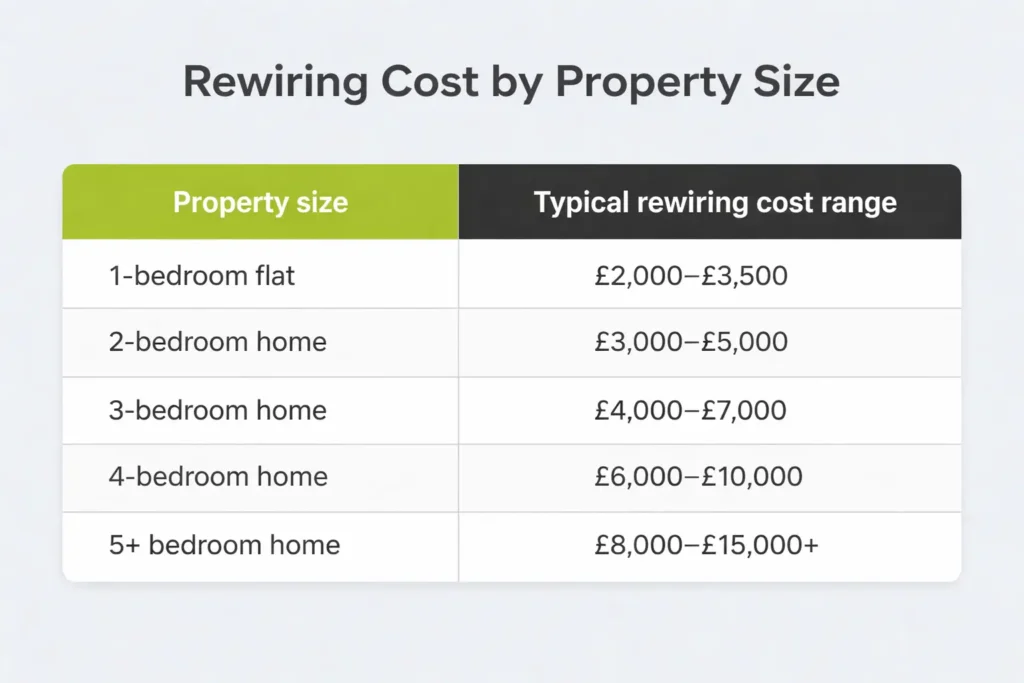
These ranges assume a full rewire with a modern consumer unit and standard accessories; premium finishes, extra outdoor circuits, EV charging provision, or extensive data cabling can increase the total. To preserve budget freedom, the simplest lever is scope: agree on socket counts, lighting zones, and kitchen/utility loads before booking.
Old-House Rewiring: Costs, Risks, Surprises
Two factors tend to make rewiring old houses less predictable than in modern properties: hidden wiring and legacy electrics. Lath-and-plaster walls, brittle timber, and irregular voids can turn a “simple” cable run into careful exploratory work, raising labour hours and patching costs. Older installations may also hide DIY additions, mixed earthing, or degraded insulation, increasing risk and necessitating meticulous testing.
Common surprises that affect price and programme include:
- Restricted cable routes behind ornate cornices, masonry, or shallow joists, requiring alternative paths and more making-good.
- Hazard controls such as lead paint or asbestos-containing materials, where safe handling and specialist clearance protect occupants’ autonomy.
- Heritage constraints, where visible changes must be minimal, push for discreet fittings and gentler methods.
For households that value freedom from recurring faults, budgeting a contingency and insisting on clear scope notes helps keep control when the walls start talking.
How Much Is an Electrical Panel/Consumer Unit Upgrade?
Once hidden wiring risks have been assessed, many projects still hinge on the consumer unit, since older fuse boards often lack modern RCD/RCBO protection and spare capacity.
A straightforward consumer unit upgrade in the UK commonly lands around £450–£900 all-in, covering a new metal-clad board, RCBOs, testing, certification, and notification. Premium boards, surge protection, or more circuits can push totals toward £1,000–£1,500. If the existing installation is tidy and accessible, labour stays contained, and power can often be restored the same day.
Where a full rewire is underway, combining the two jobs may reduce duplicate call-outs and testing time. Homeowners seeking more control often choose a larger board with additional ways for future additions, such as EV charging, heat pumps, outbuildings, or solar.
Expect a brief planned outage and a final Electrical Installation Certificate for compliance and peace of mind.

What Drives House Rewiring Costs Up or Down?
How much is rewiring a house cost? Prices rise or fall based on how quickly electricians can run new cables and certify the work, which is largely dictated by property size and layout, wall and floor construction, access to routes (loft, underfloor voids, trunking), and the amount of making-good needed afterwards.
Larger homes, split levels, and maze-like extensions slow progress and increase labour days, while open runs and clear voids keep costs lean.
Key cost drivers tend to be:
- Disruption level: Chasing plaster, lifting floors, moving furniture, and reinstating finishes can rival the electrical labour itself.
- Complexity of the spec: More circuits, sockets, data points, extractor fans, and outdoor feeds add cable, accessories, and test time.
- Risk and compliance burden: Old wiring surprises, limited earthing, damp, asbestos protocols, and out-of-hours working all raise contingency.
Freedom-friendly projects keep routes simple, decisions decisive, and access unrestricted so the crew can work fast and leave the space usable sooner.
How to Compare Rewire Quotes (Fast Checklist)
Cost swings are often explained by access, disruption, and the level of ambition in the electrical spec; the next step is to assess whether a quote reflects those realities or hides gaps that will surface as extras later.
Compare quotes with a quick checklist: scope, assumptions, and exclusions in plain English. Confirm whether it covers a full rewire vs a partial, the number of circuits, the consumer unit, earthing/bonding, smoke alarms, and testing/certification. Check access notes: lifted floors, chased walls, loft work, and whether making-good, plastering, redecorating, and waste removal are included.
Verify fixtures: socket and light counts, USB outlets, exterior points, EV charger readiness, data cabling, and downlight fire hoods. Demand a timetable, staged payments, and who coordinates power-off and notices. Look for the brand/spec of the materials and the warranty. Finally, price the same spec across bids; “cheap” often means fewer points, provisional sums, or missing compliance items.
Frequently Asked Questions
How Long Does a Typical House Rewire Take to Complete?
A typical house rewire takes 3–10 days, though larger or occupied homes may need 2–4 weeks. Timing depends on size, access, repairs, permits, and inspections, allowing owners to choose the level of disruption.
Will I Need to Move Out During the Rewiring Work?
Moving out is often not required, but it may be chosen for comfort and autonomy. Occupancy depends on home size, access to power and water, safety controls, and whether circuits are isolated room-by-room.
Does Rewiring Require Building Control Approval or Permits?
Yes, rewiring usually requires Building Control notification/approval; in England and Wales, it is notifiable under Part P unless done by a registered electrician who self-certifies. Permits may apply for listed buildings; check locally.
Can I Stay Insured if I Delay Necessary Electrical Rewiring?
Insurance can be maintained, but delaying necessary rewiring may void coverage if hazards were known and ignored. They should review policy terms, disclose material risks, document inspections, and choose timely repairs to protect autonomy and claims.
How Soon Can I Redecorate After Walls Are Chased and Replastered?
Redecoration can typically begin after the plaster has fully dried: around 2–3 days for skim coats, up to 1–2 weeks for deeper repairs. They should ensure ventilation and low humidity, then apply a mist coat first.
Conclusion
How much is rewiring a house varies widely, driven by property size, age, access, and the scope of work. A full rewire is typically pricier than a partial upgrade, but it can improve safety, reliability, and compliance. Quotes usually cover new cabling, sockets, switches, testing, and certification, with extra charges for plaster repairs and panel upgrades. Comparing itemised estimates, checking inclusions, and confirming timelines helps avoid surprises and guarantees better value.