Fire extinguishers are coded with coloured bands to indicate their contents and the types of fire they are suitable for. The main body is red. A cream band indicates foam, suited to Class A and B fires. Blue shows dry powder for A, B, C and some metal fires. Black marks CO₂ for electrical and flammable liquids. Yellow indicates wet chemical for Class F cooking oil fires. Each colour supports safer, faster choices, and the full guide explains how to apply this in real settings.
Key Takeaways
- Fire extinguishers use a red body with coloured bands to show the extinguishing medium and suitable fire classes at a glance.
- Cream band (foam): suitable for Class A (solids) and Class B (flammable liquids), not for live electrical fires.
- Blue band (dry powder): effective on Class A, B, and C (gas), and electrical fires, but creates residue and poor visibility indoors.
- Black band (CO₂): designed for electrical and Class B liquid fires, leaves no residue but offers little cooling effect, so re-ignition is possible.
- Yellow band (wet chemical): specialised for Class F kitchen fires involving hot cooking oils and fats, forming a cooling, soapy layer to prevent re-ignition.
Table of Contents
Why Fire Extinguisher Colour Codes Matter
Fire extinguisher colour codes matter because they provide an immediate visual guide to the type of fire each extinguisher can safely tackle, reducing hesitation and error in emergencies. When people know that a quick glance reveals what tool to grab, they are less dependent on gatekeepers, manuals, or lengthy instructions. Colour becomes a fast, empowering shortcut.
Clear coding also prevents dangerous improvisation. In a crisis, someone might reach for whatever is closest; colour breaks that pattern, steering them toward the right option without debate or delay. This protects lives, property, and the right to act without waiting for official help.
Colour codes further support self-reliant workplaces and homes. Anyone can learn them, regardless of rank or role, which spreads safety knowledge horizontally rather than hoarding it hierarchically.
In that way, extinguisher colours quietly defend autonomy: they simplify decisions and let people respond on their own terms.
Fire Classes And What They Mean
Different fire classes group fires by what is actually burning and how that fuel behaves. Instead of treating every blaze the same, this system recognises that paper, gasoline, and electrified metal do not burn or respond to control in identical ways. Knowing the class lets people act quickly without surrendering safety or autonomy to guesswork.
- Class A covers common combustibles: wood, paper, cloth, and many plastics.
- Class B refers to flammable liquids and gases such as petrol, oils, and solvents.
- Class C involves live electrical equipment, where current poses additional risk.
- Class D addresses combustible metals like magnesium or sodium, usually found in specific industrial settings.
- Class F (or K in some regions) covers high‑temperature cooking oils and fats in kitchens.
These distinctions empower occupants and workers to recognise danger accurately, choose appropriate actions, and prevent a controllable incident from becoming a life‑limiting disaster.
Fire Extinguisher Colour Codes Explained
Although extinguishers may look similar at a glance, their colour bands provide a clear code for the agent inside and the types of fires they can safely tackle. Instead of relying on memory-heavy rules, users can scan these visual signals and act quickly without hesitation. The system turns a cluttered line of cylinders into a readable set of options, supporting fast, independent decision‑making in tense moments.
In many regions, the main body is red, while a bold band or block of colour wraps around the upper section. This band identifies the medium inside powder, foam, water, CO₂, or wet chemical without forcing anyone to search for small print or technical labels. The code is designed to be understood at a distance and through smoke, empowering people to respond on their own terms.
| Visual Feature | What It Tells The User |
| Body colour | Overall extinguisher type |
| Band colour | Specific extinguishing medium |
| Label text | Additional usage details |
Matching Each Colour To The Right Fire Type
Once the colour bands are understood, each one must be matched to the correct fire class so the extinguisher is used safely and effectively. This knowledge lets people act fast without waiting for outside help, retaining control when heat and smoke threaten to box them in.
Red‑label water extinguishers are for Class A fires: wood, paper, textiles, and other solid combustibles.
Cream‑label foam tackles both Class A and Class B fires involving flammable liquids such as petrol or paints. Blue‑label dry powder is versatile, covering Class A, B, C (flammable gases), and appropriate electrical fires. Black‑label CO₂ targets live electrical fires and flammable liquid fires, limiting damage to equipment because it leaves no residue.
Yellow‑label wet chemical is specialised for Class F fires involving hot cooking oils and fats.
Where To Use Each Extinguisher Colour On Site
When extinguisher colour codes move from theory to a building layout, each type must be positioned where its corresponding fire risks are most likely to occur.
Red‑label water units sit in corridors, stairwells, and office areas dominated by solid combustibles. Cream‑label foam belongs near parking areas, fuel stores, and plant rooms where flammable liquids are present. Blue‑label dry powder suits workshops, loading bays, and outdoor zones with vehicles, gas cylinders, or mixed hazards, where flexibility matters more than spotless air.
Black‑label CO₂ is placed beside electrical panels, server rooms, and equipment clusters, giving people a clean way to cut power‑related fires without residue. Yellow‑label wet-chemical stands are located near commercial kitchens, food trucks, and catering stations, ready for high‑energy cooking-oil fires.
In every case, placement follows activity: wherever people work with heat, power, fuel, or movement, the matching extinguisher colour should be immediately reachable.
Common Colour Code Mistakes To Avoid
Despite clear guidance in standards and training, fire extinguisher colour codes are frequently misapplied in everyday settings, undermining both safety and compliance.
Many workplaces rely on habit, assumption, or legacy layouts, rather than checking whether the colour actually matches the extinguisher’s agent and approved use. This casual approach can leave people feeling prepared while, in reality, critical gaps remain hidden.
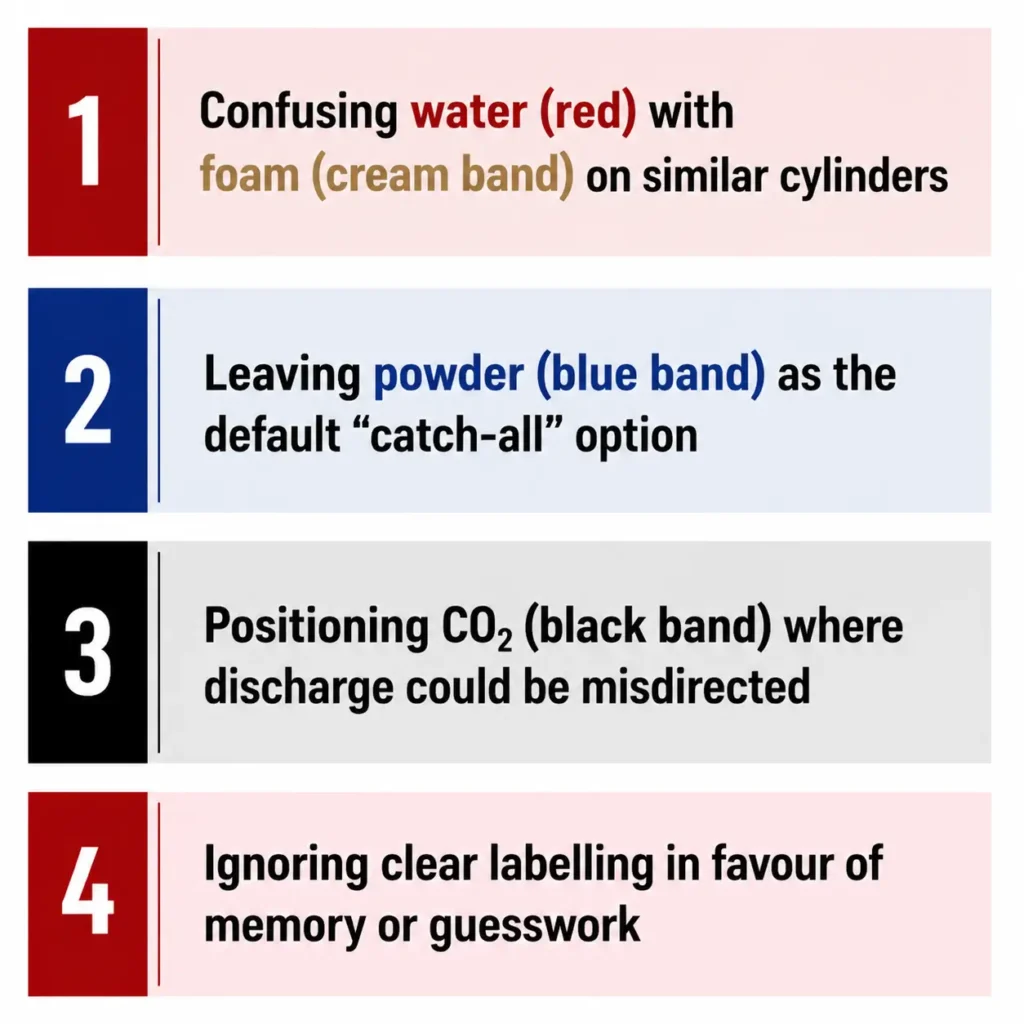
Common mistakes include mixing obsolete and current colour schemes, assuming red means “safe for anything,” or treating all blue or cream labels as interchangeable. Such errors restrict real choice in an emergency and can turn a small incident into a major loss of freedom, assets, and time.
Key pitfalls typically include:
Training Your Team On Extinguisher Colour Codes
Preventing these colour code errors depends less on posters on the wall and more on how teams are trained to recognise and apply them under pressure. Effective training respects people’s desire for autonomy; it equips them with the knowledge and practice to act quickly without waiting for orders.
A practical programme avoids dry lectures and focuses on short, scenario‑based drills. Team members handle each extinguisher, repeat the colour codes aloud, and match them to fire classes and real equipment on site.
Regular micro‑drills for two to five minutes during normal shifts keep knowledge alive without feeling like control. Trainers encourage questions such as “What would you do if…?” to help individuals think independently rather than just follow scripts.
Visual walk‑throughs of the building, combined with timed practice to locate the right extinguisher, build confidence. Finally, brief refreshers after any incident or near‑miss lock in lessons while they are still vivid.
Frequently Asked Questions
Can I Use Colour-Coded Fire Extinguishers in a Home Setting?
Yes, colour‑coded fire extinguishers can be used at home. They help people quickly match extinguisher type to fire risk. Users should learn basic codes, prioritise multi‑purpose units, and guarantee safe storage, visibility, and regular maintenance.
How Often Should Fire Extinguisher Labels and Colours Be Inspected?
They should be inspected visually at least monthly and formally checked annually. A freedom‑minded user verifies labels, colours, seals, pressure gauges, and accessibility, documenting issues and arranging professional servicing whenever damage, fading, or confusion appears.
Do Fire Extinguisher Colour Codes Differ Between Countries?
Yes, fire extinguisher colour codes differ between countries. Some follow European EN3 with red bodies and coloured bands; others, like older UK or US systems, use fully coloured cylinders. Users must check local regulations before relying on colours.
How Do Colour-Blind Users Identify the Correct Fire Extinguisher?
They rely on bold printed labels, tactile markings, and icon-based instructions rather than colour alone. Clear signage, consistent extinguisher placement, and regular hands-on training further empower colour-blind individuals to independently choose and use the correct extinguisher.
Are Digital or Smart Labels Replacing Traditional Colour Codes?
Digital and smart labels are emerging, but not fully replacing traditional colour codes. They run alongside existing systems, offering QR-linked data, icons, and audio cues, empowering users with more accessible, choice-driven safety information without erasing familiar standards.
Conclusion
Understanding fire extinguisher colour codes is essential for any safe workplace or site. By linking each colour to the correct fire class, teams can respond quickly and effectively in an emergency. Clear signage, correct placement, and regular inspections further reduce risk. Avoiding common mistakes and investing in practical training guarantees that every team member recognises and correctly uses the right extinguisher. Ultimately, accurate colour code knowledge can prevent injuries, protect property, and save lives.