A risk assessment starts by setting goals, scope, and acceptable risk levels. It then identifies hazards, who could be harmed, and how. A risk matrix rates likelihood and impact to prioritise risks. Controls are chosen using the hierarchy of control, favouring elimination and engineering measures over PPE. The assessment is documented, communicated, and supported by training. Regular reviews guarantee it stays accurate, protect autonomy, and adapt to real-world changes, as the following steps unpack in more detail.
Key Takeaways
- Define the scope, objectives, legal duties, people affected, and what level of risk is acceptable before you start.
- Identify hazards systematically (physical, environmental, chemical, procedural) using walk-throughs, task observations, and worker input.
- Determine who might be harmed and how, including vulnerable groups, exposure locations, and types of potential harm.
- Assess the likelihood and impact of each hazard using a risk matrix, then prioritise them as low, medium, high, or extreme.
- Select and implement controls using the Hierarchy of Controls, document them clearly, train people, and review their effectiveness regularly.
Table of Contents
Set the Goal and Scope of Your Risk Assessment
A risk assessment begins by defining exactly what it aims to protect and why. Before any forms or checklists appear, the assessor chooses the core freedoms at stake: life, health, privacy, autonomy, livelihood, or continuity of operations. This clarity prevents the process from drifting into box‑ticking and keeps it anchored to real human interests.
Next comes scope. The assessor specifies which activities, locations, systems, or groups fall inside the assessment and which remain outside. They identify legal duties, contractual obligations, and ethical commitments that limit interference with people’s choices. Timeframes are set: is this a one‑time review or a living process to be revisited regularly?
Finally, the organisation defines acceptable and unacceptable levels of risk, making explicit the extent of disruption, control, or expense it is willing to impose. Clear goals and scope guarantee that the assessment protects people’s freedom rather than quietly eroding it.

Spot Hazards for Your Risk Assessment
Once the goal and scope are defined, the next step is to identify what could realistically cause harm within those boundaries. At this stage, the focus is on spotting anything that might restrict people’s ability to act, move, or work freely and safely.Hazards can be physical (machinery, vehicles, heights), environmental (noise, extreme temperatures, poor lighting), chemical (solvents, fumes, dust), or procedural (complex steps, rushed timelines, unclear instructions).
A systematic walk-through of the space helps reveal what is easy to overlook from a desk. Observing tasks as they are actually performed, not just as they are written in procedures, exposes shortcuts, workarounds, and friction points that may threaten autonomy and safety alike.
Consulting equipment manuals, incident records, and maintenance logs can highlight less visible threats such as hidden failure modes or recurring near-misses. Each identified hazard becomes a candidate for control, redesign, or elimination.
Identify Who Your Risk Assessment Covers and How They Could Be Harmed
Clarity about who might be harmed turns a list of hazards into a meaningful risk assessment. Instead of treating “people” as a vague category, the assessor defines distinct groups whose ability to live and work freely could be constrained if something goes wrong. This includes those on-site every day and those who simply pass through but still carry the risk.
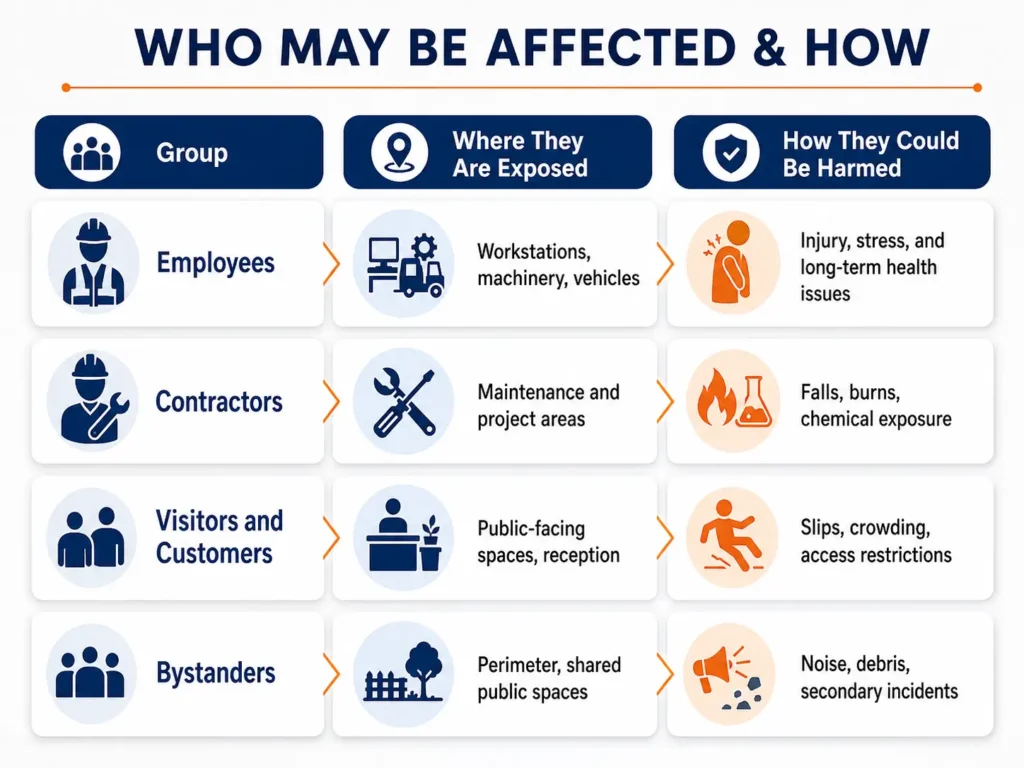
A thorough assessment also considers pregnant workers, young workers, disabled people, lone workers, and remote staff. By mapping hazards to real humans and their freedoms movement, privacy, bodily integrity the organisation sees why controls matter.
Use a Risk Assessment Matrix to Rate Likelihood and Impact
Risk assessment gains structure and consistency when each hazard is scored for how likely it is to occur and how severe the consequences would be.
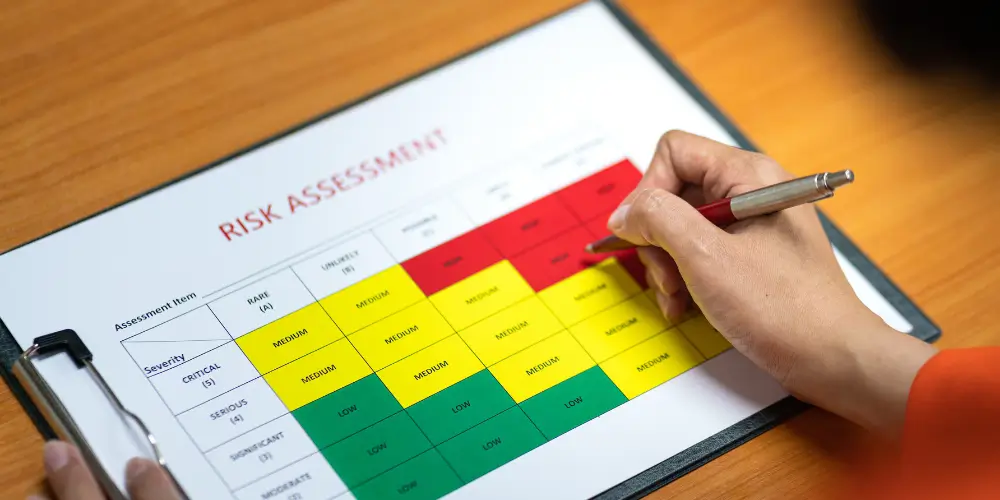
A risk assessment matrix turns that judgment into a visual grid, usually with likelihood on one axis and impact on the other. This lets people see, at a glance, which threats most endanger their ability to work, move, speak, or live as they choose. To build the matrix, they define simple likelihood levels (for example: rare, unlikely, possible, likely, almost certain) and impact levels (for example: insignificant, minor, moderate, major, catastrophic).
Each combination receives a risk rating, often expressed as low, medium, high, or extreme.
Prioritise Risks in Your Assessment and Choose Controls
With each hazard assigned a likelihood and impact rating, the next step is to decide which risks demand attention first and what actions will reduce them. The matrix highlights combinations of high likelihood and severe impact as the most urgent constraints on people’s autonomy, health, and time.
These risks are prioritised above moderate or low ones, even if they feel less visible day to day. Prioritisation can be done by ranking each hazard’s overall risk level, then listing them in order from “intolerable” to “acceptable.” High‑level risks are scheduled for immediate action, with clear responsibilities and deadlines.
Medium‑level risks are planned for systematic improvement, while low‑level risks are monitored to guarantee they do not grow. Choosing controls then becomes a practical exercise in removing unnecessary limits: identifying what can be changed now, what requires investment, and what organisational commitments are needed to keep risk within agreed boundaries.
Apply the Hierarchy of Control to Reduce Risk
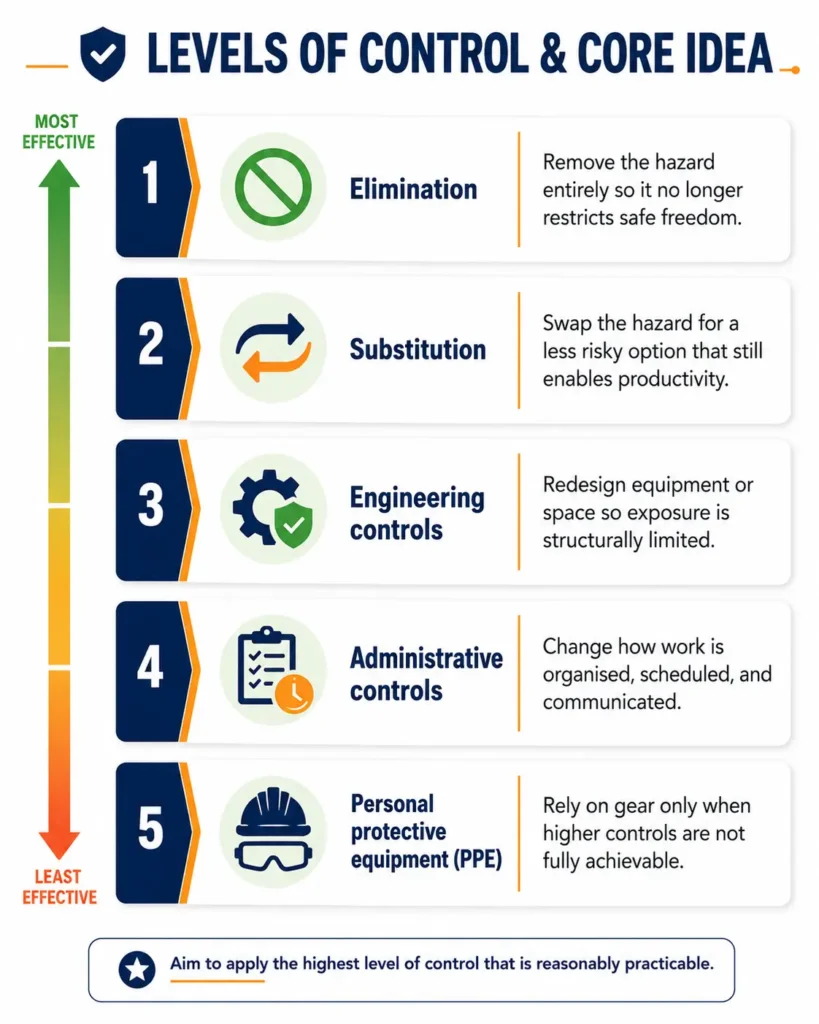
Having prioritised which hazards matter most, the next step is to reduce them using the hierarchy of control, a structured order of preferred safety measures. This approach aims to remove constraints on people’s choices by tackling danger at its source, rather than relying only on individual caution.
Record Your Risk Assessment and Meet Legal Requirements
Once control measures are chosen, the assessment must be documented clearly so that it can be acted on, reviewed, and, where necessary, presented to regulators. A written record protects both people and autonomy: it shows that risks are understood, that controls are intentional, and that choices are based on evidence rather than bureaucracy.
The record typically includes hazards identified, who might be harmed, existing controls, chosen additional measures, and residual risk. Dates, responsible persons, and review intervals are also captured so that the document remains a living tool, not a static file.
Legal requirements vary by jurisdiction, but most expect written assessments where there are employees, significant hazards, or regulated activities. By keeping records proportionate and detailed where risk is higher, lighter where it is low an organisation stays compliant without drowning in paperwork, retaining room to innovate and adapt. Periodic review guarantees the documented assessment stays aligned with changing realities.
Communicate Your Risk Assessment and Train on Controls
Effective risk assessment does not end at documentation; it must be translated into clear communication and practical training so people know what to do differently.
Once risks and controls are defined, the findings need to be shared in plain, direct language that explains what might go wrong, why it matters, and how each person can act to prevent harm without feeling micromanaged.
Communication should highlight choices, not just rules: what flexibility exists, what’s non‑negotiable, and where judgment is expected. Visual summaries, short briefings, and quick-reference guides help people understand controls without being buried in paperwork.
Training should be focused, scenario-based, and relevant to real work. Rather than lecturing, it should invite questions and encourage individuals to challenge assumptions and suggest better ways of managing risk. When people see how controls protect both their autonomy and their safety, they are far more likely to apply them consistently.
Review and Improve Your Risk Assessment Regularly
Clear communication and training make a risk assessment usable, but keeping it accurate requires regular review and refinement. A static assessment can slowly turn into a constraint, while a living one protects space for choice, innovation, and responsible risk‑taking.
Regular reviews let an organisation drop obsolete controls, respond to new threats, and avoid knee‑jerk restrictions after incidents. Reviews should be scheduled at least annually and also triggered by significant changes in operations, technology, law, or strategy.
Lessons from incidents, near misses, and employee feedback should be fed back into the assessment, ensuring it reflects reality rather than bureaucracy.
Key practices include:
- Compare identified risks against current operations and priorities
- Re‑evaluate likelihood and impact using fresh data and trends
- Test whether controls still work, or quietly block productive freedom
- Remove or redesign controls that add burden without a clear benefit
- Document changes and communicate why adjustments expand safe autonomy
Frequently Asked Questions
How Often Should Small Businesses Perform a Full Risk Assessment Review?
Small businesses should perform a full risk assessment review at least annually, with additional reviews after major changes, incidents, or regulatory shifts, empowering owners to stay agile, protect autonomy, and adapt defences as their operations and threats evolve.
What Software Tools Can Streamline Documenting and Updating Risk Assessments?
They can streamline documentation with tools like Resolver, LogicGate, and ZenGRC; leverage SharePoint or Confluence for living registers; use Power BI or Tableau for visual updates; and automate workflows via Jira, ServiceNow, or custom low‑code platforms.
How Do Insurance Requirements Interact With My Workplace Risk Assessment Process?
Insurance requirements shape the risk assessment’s baseline, but don’t cap ambition. The assessor compares policy conditions with real hazards, then documents controls exceeding insurer demands, preserving operational freedom while ensuring compliance, lower premiums, stronger defences, and leverage in claim disputes.
Who Should Be Involved in Cross‑Departmental Risk Assessment Workshops?
Cross‑departmental risk workshops should include empowered representatives from each team, safety and compliance leads, HR, frontline workers, union or worker advocates, and senior decision‑makers, ensuring diverse perspectives, transparent trade‑offs, and shared ownership of both constraints and creative solutions.
How Can I Adapt Risk Assessments for Remote and Hybrid Workers?
They adapt risk assessments by mapping digital workflows, surveying remote setups, emphasising outcome‑based controls, strengthening cyber and ergonomic safeguards, revising communication protocols, enabling worker choice in tools, and continuously recalibrating risks through lightweight, data‑driven check‑ins rather than rigid oversight.
Conclusion
By following these key steps, organisations can approach risk assessment as a structured, repeatable process rather than a one‑off exercise. Clearly defining scope, identifying hazards, rating risks, and applying appropriate controls allows them to protect people, operations, and assets more effectively. Recording, communicating, and regularly reviewing assessments ensures that legal requirements are met and controls remain relevant. Ultimately, a well‑managed risk assessment process supports safer workplaces and more resilient business performance.