PAT testing is it a Legal Requirement is not a legal requirement in the UK, but duty holders must guarantee electrical equipment is safe under the Electricity at Work Regulations 1989 and broader health and safety law. PAT is simply a common way to show portable appliances are inspected, maintained, and fit for use, based on a risk assessment. Employers, landlords, and business owners remain responsible even if contractors test. Record keeping matters, especially after incidents, and the details below explain what to do.
Key Takeaways
- PAT testing isn’t legally mandatory in the UK, but electrical equipment must be kept safe under the Electricity at Work Regulations 1989.
- Employers must manage electrical risks, typically through risk assessments, inspections, and maintenance under the Health and Safety at Work Act 1974.
- PAT is a common way to show compliance, but low-risk equipment may only need user checks and periodic visual inspections.
- Testing frequency should be risk-based, considering usage, environment, and equipment condition, rather than fixed annual schedules.
- Duty holders remain responsible even if contractors test, and must keep records of assets, results, dates, and remedial actions.
Table of Contents
Is PAT Testing a Legal Requirement in the UK?
In the UK, PAT testing is not explicitly mandated by law, but employers and duty holders are legally required to guarantee that electrical equipment is safe to use under the Electricity at Work Regulations 1989 and related health and safety legislation.
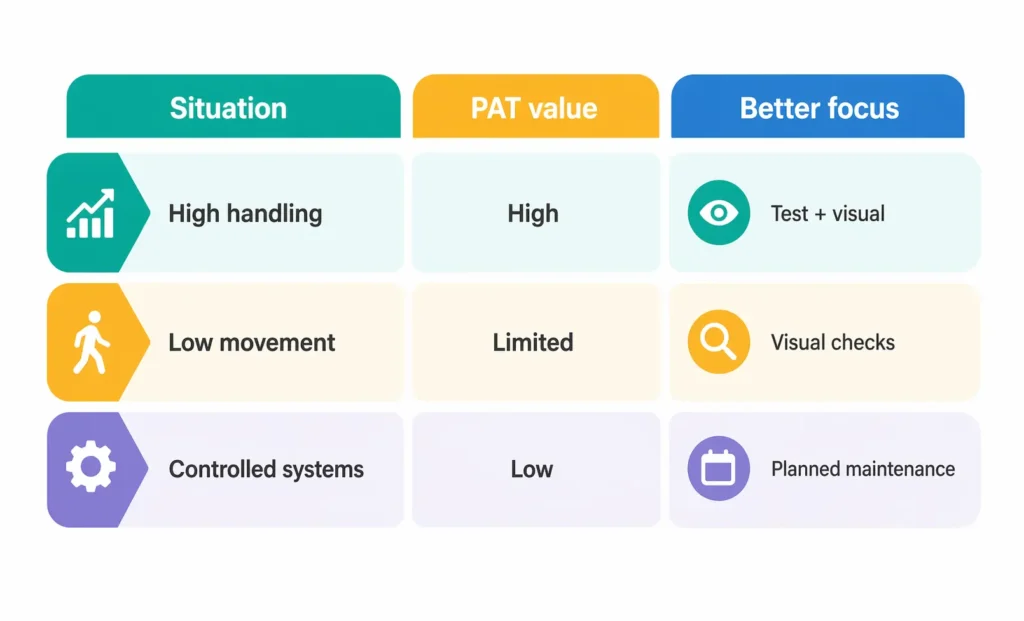
PAT is simply one widely used way to demonstrate that freedom to operate comes with sensible risk control, not blanket bureaucracy. Whether PAT is “required” depends on context. If equipment is low-risk, double-insulated, and rarely moved, a business may rely on user checks, visual inspections, and robust maintenance routines.
If equipment is portable, frequently handled, used by the public, or exposed to harsher environments, formal testing becomes a practical expectation, often demanded by insurers, landlords, clients, or venue operators. The key point is the choice of method: the law cares about outcomes and safe equipment, while PAT is an optional tool to support that, document diligence, and keep operations running without unnecessary restrictions.

If PAT Isn’t Mandatory, What Does the Law Require Instead?
Although PAT Testing is optional, the law requires employers and other duty holders to ensure that electrical equipment is constructed, maintained, and used so that it does not pose a danger, supported by a suitable risk assessment, competent inspection and maintenance, and clear records where needed to demonstrate ongoing control of electrical risks.
In practice, this means choosing equipment fit for purpose, installing it correctly, and keeping it in a safe condition throughout its working life. Controls can include user checks, visual inspections, scheduled maintenance, and, where justified, instrument testing, but the method and frequency should match real-world risk, not a fixed calendar.
Higher-use, harsher environments and equipment with a history of damage demand tighter oversight; low-risk, lightly used items may need less. Work should be done by competent people who understand hazards and limits, and defects must be removed from service promptly.
Documentation is a tool for accountability, not bureaucracy: enough to show hazards were assessed, actions taken, and safety is being actively managed.
Which UK Laws Set the Electrical Safety Duty?
Electrical equipment safety duties in the UK are set out in general health and safety legislation rather than in any single rule that mandates PAT testing. The core duty is to keep equipment safe so people are not exposed to electrical danger, while leaving organisations free to choose proportionate controls.
- Health and Safety at Work etc. Act 1974: sets broad duties to protect employees and others affected by work activities, making electrical safety a baseline expectation.
- Electricity at Work Regulations 1989: requires electrical systems to be constructed, maintained, and used to prevent danger, including inspection and testing where needed.
- Management of Health and Safety at Work Regulations 1999: requires risk assessment and suitable preventive measures, so inspection frequency can reflect real conditions, not box-ticking.
Together, these laws create a flexible, risk-based framework: evidence of maintenance, inspections, and fault management matters more than the label on the method used to achieve compliance.
Who Is Responsible for PAT Testing and Electrical Safety?
Who carries the duty for PAT testing and wider electrical safety? In the UK, responsibility lies with the “duty holder”: the employer, landlord, business owner, facilities manager, or self‑employed person who controls the premises and provides or allows others to use electrical equipment.
This role cannot be outsourced, even if contractors are hired. A competent person may carry out inspection and testing, whether an in‑house technician or an external specialist. Competence means suitable knowledge, training, and the ability to recognise hazards and act on findings, not simply owning a tester. Management remains responsible for setting intervals, keeping records, acting on failures, and removing unsafe items from service.
When multiple parties share a site, responsibilities should be agreed in writing to ensure control is clear and no gaps arise. Clear ownership protects people while preserving choice and minimising unnecessary disruption.
Which Appliances and Equipment Need PAT Testing?
With a duty holder identified and competence arranged, the next step is to decide which items on site should be included in portable appliance testing.
In practice, PAT covers electrical equipment that can be moved and is connected to a supply via a plug, lead, or charger, including devices used for work, hire, or public access. The aim is simple: keep people free to operate without avoidable electrical risk or needless restrictions.
A practical scope typically includes:
- Plug-in appliances with flexible leads (kettles, microwaves, vacuums, fans, printers).
- Handheld or mobile tools and IT powered by adaptors (drills, grinders, laptops, monitors, phone chargers).
- Extension leads and accessories that distribute power (multiway adaptors, reels, power strips, IEC leads).
Fixed wired installations are generally addressed through installation inspection, not PAT, but plug-connected equipment attached to benches or walls may still fall within PAT if it can be unplugged and moved.
Clear asset lists and labels preserve autonomy while keeping oversight proportionate.
When Is PAT Testing Recommended (and When Isn’t It)?
Although PAT Testing Is It a Legal Requirement is often treated as a default compliance task, it is best used as a targeted control where the likelihood of damage or misuse makes plug-in equipment a credible source of shock or fire risk, and it is less appropriate where items are low-risk, rarely moved, or already managed through other inspection regimes. It is recommended that organisations seek practical assurance without locking themselves into box-ticking: for example, portable tools, extension leads, hired kit, kitchen appliances in shared areas, and devices handled by many people. It is also sensible after repair, alteration, or a change of environment that increases strain on cables and plugs. It is not recommended as a blanket rule for fixed, hard-wired systems, SELV/USB-only devices, or items already governed by specialist maintenance plans.
How Often Should PAT Testing Be Done (Risk-Based)?
No single PAT testing interval fits every workplace; frequency should be set by risk, not habit. A sensible approach weighs the likelihood of damage, the severity of harm, and how quickly faults would be noticed.
Low-risk, well-protected equipment in stable offices may need only occasional checks, while hard-used or frequently moved items warrant closer attention. The aim is control without unnecessary disruption: test when it meaningfully reduces risk, not to satisfy a calendar.
- Environment and use: construction, workshops, events, kitchens, and outdoor use typically justify shorter intervals than fixed indoor office use.
- Equipment type and condition: heaters, extension leads, and portable tools often face more stress than the fixed IT kit; older or repaired items may need more frequent attention.
- User behaviour and supervision: trained users who spot damage early can extend intervals; high turnover or public access usually shortens them.

What Records Count as PAT Testing Compliance Evidence: and What Happens if You Have None?
How can an organisation prove its electrical safety controls are in place if challenged by an insurer, auditor, or the HSE without clear PAT-related evidence?
Compliance evidence usually means more than a sticker on a plug. Useful records include an up-to-date asset register, inspection and test results (pass/fail, readings, test method), the appliance ID and location, test dates and due dates, who carried out the checks and their competence, and documented remedial actions (repairs, retests, withdrawals). Digital logs or paper schedules both count if they are accurate, retrievable, and linked to the equipment in use.
If there are no records, the organisation loses the ability to demonstrate a risk-based system and may struggle to defend decisions after an incident. Insurers can query cover, auditors may raise nonconformities, and enforcement bodies can treat missing evidence as weak control leading to improvement notices, prosecution risk, and disruption.
Frequently Asked Questions
Do I Need to PAT Test Appliances When Working From Home?
They generally do not need to PAT test home appliances unless their employer or insurer requires it. Safety duties still apply, so users can choose simple checks, document issues, and repair or replace unsafe equipment.
Does PAT Testing Apply to Rented Residential Properties and Landlords?
PAT testing can apply to rented homes when landlords supply electrical appliances; it’s not always mandated, but safety duties remain. Landlords should inspect, test as needed, keep records, and empower tenants through safe, well-maintained equipment.
Can I PAT Test My Own Equipment, or Must I Hire a Professional?
Own equipment can be PAT-tested personally if competent, using proper procedures and calibrated tools, and keeping records. A professional isn’t mandatory, but hiring one can offer confidence and independence and may satisfy insurers or landlords.
How Much Does PAT Testing Typically Cost per Item or per Site?
PAT testing typically costs £1–£5 per item in bulk, or £50–£150 per site call‑out, with larger sites costing £200+. Prices vary by item count, complexity, travel, and reporting, letting clients choose speed and independence.
Will My Insurance Be Invalidated if I Don’t Have PAT Testing Records?
Insurance is not automatically invalidated without PAT records; it depends on policy terms and proof of safe maintenance. Insurers may reduce payouts or reject claims if negligence is shown. Keeping records supports autonomy and flexibility.
Conclusion
PAT Testing Is It a Legal Requirement is not explicitly mandated by UK law, but employers and duty holders must guarantee that the electrical equipment is safe to use and maintained in a safe condition. Compliance is typically achieved through a risk-based programme that may include formal inspection, combined inspection and testing, user checks, and appropriate maintenance. Responsibility lies with those who control the workplace or equipment. When testing is required, suitable intervals and clear records provide practical evidence of due diligence and help demonstrate legal compliance in the event of incidents.